General Chemistry I + Lab
Atoms, reactions, bonds, gases and energy, with three hands-on labs. Free, self-paced, and tied to real planet-saving work.
Courses › CHEM 110 + CHEM 110L
About this course
This is a free self-study course outline written by Saving Planets. It is not a university course, it carries no academic credit, and no school is involved.
Its scope follows the first semester of college general chemistry as taught in open materials such as OpenStax Chemistry 2e and MIT OpenCourseWare, which we link to throughout. Those organizations do not endorse this page.
Work through it in order. Each unit has goals, key ideas, equations, step-by-step examples, practice with answers, common mistakes, flashcards and a quiz. Your progress is saved only in this browser.
How this course helps save the planet
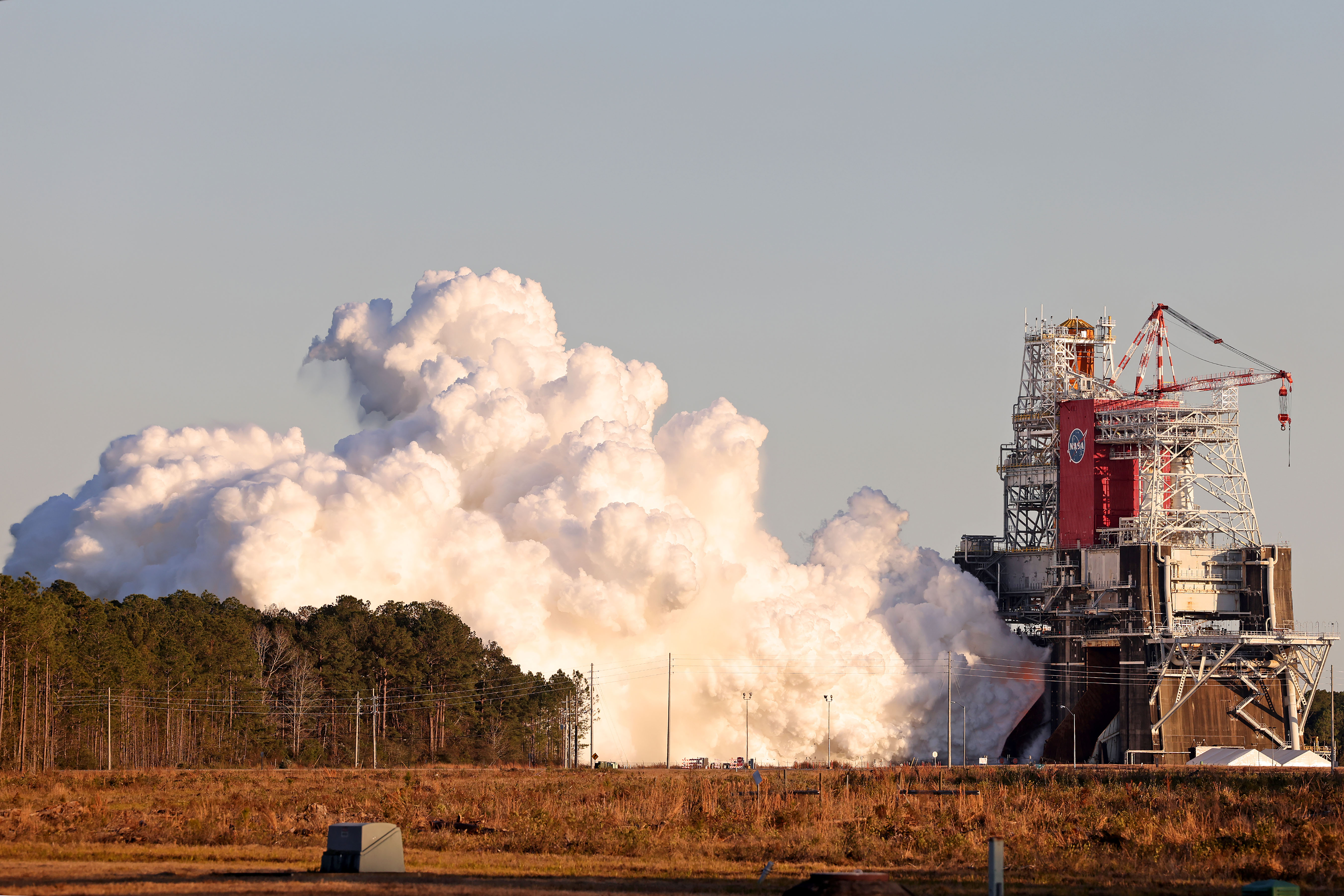
Chemistry sits behind many of the solutions on Saving Planets: measuring greenhouse gases from orbit, testing water, turning CO₂ into stone, and building cleaner fuels and rockets.
Each unit ends with a short, sourced section showing how its ideas help both people and nature.
Before you start
Prerequisites
- Algebra: solving for one unknown, rearranging formulas, ratios and percentages.
- Scientific notation and logarithms (base 10). You will use log for pH and absorbance.
- Units: converting grams to kilograms, mL to L, °C to K.
- A scientific calculator. A phone calculator in scientific mode works.
How to study
- Read the unit, then close it and try the worked examples yourself before checking each step.
- Do every practice problem on paper before opening the answer. Getting it wrong first and fixing it is how the method sticks.
- Always carry units through a calculation. If the units do not cancel to the answer you want, the setup is wrong.
- Check significant figures: your answer should not be more precise than your least precise measurement.
- Use the flashcards for 10 minutes a day (spaced practice beats one long cram).
- Take the unit quiz only when you think you are ready. Below 80 percent, review the misconceptions and try again tomorrow.
- Explain one idea out loud each day, as if teaching it. If you get stuck, that is the part to review.
Lab equipment (for the wet labs)
- Digital balance (to 0.001 g)
- pH meter or probe
- Spectrophotometer or colorimeter with cuvettes
- Burette, volumetric pipets and flasks
- Crucible, lid, clay triangle and burner
- Safety goggles, gloves and lab coat
Suggested 15-week schedule
About 6 to 9 hours a week: reading, practice problems and, in lab weeks, the lab.
| Week | Unit | Topics | Reading |
|---|---|---|---|
| 1 | Atomic Theory & Quantum Numbers | Atoms, isotopes and average atomic mass | OpenStax 2.2–2.3 |
| 2 | Atomic Theory & Quantum Numbers | Light, photons and the Bohr model of hydrogen | OpenStax 6.1–6.2 |
| 3 | Atomic Theory & Quantum Numbers | Quantum numbers, electron configurations, periodic trends | OpenStax 6.3–6.5 |
| 4 | Stoichiometry | The mole, molar mass and formulas | OpenStax 3.1–3.2 |
| 5 | Stoichiometry | Balancing equations and reaction stoichiometry · Lab A | OpenStax 4.1, 4.3 |
| 6 | Stoichiometry | Limiting reactant, yield, molarity and dilution · Lab B | OpenStax 3.3, 4.4–4.5 |
| 7 | Molecular Geometry & Bonding | Ionic and covalent bonds, electronegativity, Lewis structures | OpenStax 7.1–7.4 |
| 8 | Molecular Geometry & Bonding | VSEPR shapes and molecular polarity | OpenStax 7.6 |
| 9 | Molecular Geometry & Bonding | Intermolecular forces · Midterm practice set | OpenStax 10.1 |
| 10 | States of Matter: Gases & Solutions | Gas laws and the ideal gas law | OpenStax 9.1–9.3 |
| 11 | States of Matter: Gases & Solutions | Gas mixtures, partial pressure, kinetic-molecular theory | OpenStax 9.3–9.5 |
| 12 | States of Matter: Gases & Solutions | Solutions and gas solubility · Lab C | OpenStax 11.1–11.3 |
| 13 | Thermodynamics | Energy, heat, specific heat and calorimetry | OpenStax 5.1–5.2 |
| 14 | Thermodynamics | Enthalpy, Hess’s law, intro to entropy and Gibbs energy | OpenStax 5.3, 16.1–16.4 |
| 15 | Review | Review, flashcards and the final practice set | All units |
Your progress
Tick units and labs as you finish them, and take the quizzes. Progress and quiz scores are saved only in this browser, never sent to us.
Turn on JavaScript to track progress.
Unit 1 · Weeks 1–3
Atomic Theory & Quantum Numbers
What atoms are made of, how electrons are arranged, and why each element gives off its own colors of light.
Learning objectives
By the end of this unit you can:
- Find protons, neutrons and electrons from an isotope symbol, and compute an average atomic mass.
- Use c = λν and E = hν to move between wavelength, frequency and photon energy.
- Find the wavelength of light given off when a hydrogen electron drops between levels.
- List the allowed quantum numbers (n, l, mₗ, mₛ) and spot impossible sets.
- Write electron configurations and orbital diagrams, including ions and noble-gas shorthand.
- Explain periodic trends in atomic radius and ionization energy.
Key concepts
- An atom has a tiny nucleus of protons and neutrons with electrons around it. The atomic number Z counts protons; the mass number A counts protons plus neutrons.
- Isotopes are atoms of the same element with different numbers of neutrons. The atomic mass on the periodic table is a weighted average of the isotopes found in nature.
- Light behaves as a wave (wavelength λ, frequency ν) and as particles called photons, each carrying energy E = hν.
- Electrons in an atom can only have certain energies. When an electron drops to a lower level it gives off a photon whose energy equals the gap, so every element has its own line spectrum.
- Four quantum numbers describe each electron: n (shell, 1, 2, 3…), l (subshell shape, 0 to n − 1, named s, p, d, f), mₗ (orientation, −l to +l) and mₛ (spin, +½ or −½).
- Pauli exclusion principle: no two electrons in an atom share all four quantum numbers, so an orbital holds at most two electrons, with opposite spins.
- Aufbau principle: fill the lowest-energy orbitals first (1s, 2s, 2p, 3s, 3p, 4s, 3d, 4p…). Hund’s rule: in equal-energy orbitals, place electrons singly with parallel spins before pairing.
- Across a period, atoms get smaller and ionization energy generally rises because the nuclear charge felt by the outer electrons grows. Down a group, atoms get larger and ionization energy falls.
Key equations
Worked examples, step by step
Example 1.1 What wavelength of light does a hydrogen atom give off when its electron drops from n = 3 to n = 2?
Show the steps
- Energy gap: |ΔE| = k(1/2² − 1/3²) = 2.179 × 10⁻¹⁸ J × (1/4 − 1/9) = 2.179 × 10⁻¹⁸ J × 5/36 = 3.026 × 10⁻¹⁹ J.
- Rearrange E = hc/λ to λ = hc/E.
- λ = (6.626 × 10⁻³⁴ J·s × 2.998 × 10⁸ m/s) ÷ 3.026 × 10⁻¹⁹ J = 6.564 × 10⁻⁷ m.
- Convert: 6.564 × 10⁻⁷ m = 656 nm.
Answer: 656 nm, red light. This is the bright red line in the hydrogen spectrum that astronomers use to spot hydrogen gas in space.
Example 1.2 Write the electron configuration of iron (Fe, Z = 26) and of the Fe²⁺ ion. How many unpaired electrons does Fe have?
Show the steps
- Fill in order with 26 electrons: 1s² 2s² 2p⁶ 3s² 3p⁶ 4s² 3d⁶.
- Shorthand: argon has 18 electrons, so Fe = [Ar] 4s² 3d⁶.
- Hund’s rule for 3d⁶: five d orbitals get one electron each, then one pairs up. That leaves 4 unpaired electrons.
- Transition metals lose their 4s electrons first when they form ions, so Fe²⁺ = [Ar] 3d⁶.
Answer: Fe = [Ar] 4s² 3d⁶ with 4 unpaired electrons; Fe²⁺ = [Ar] 3d⁶.
Example 1.3 Chlorine is 75.76% chlorine-35 (34.969 u) and 24.24% chlorine-37 (36.966 u). What is its average atomic mass?
Show the steps
- Convert percentages to fractions: 0.7576 and 0.2424.
- Multiply each mass by its fraction: 0.7576 × 34.969 u = 26.49 u; 0.2424 × 36.966 u = 8.961 u.
- Add: 26.49 u + 8.961 u = 35.45 u.
Answer: 35.45 u, which matches the periodic table value for chlorine.
Practice problems
Work each on paper first, then check.
How many protons, neutrons and electrons are in one atom of carbon-14?
Show answer
6 protons, 8 neutrons (14 − 6) and 6 electrons.
A green laser has a wavelength of 532 nm. Find its frequency and the energy of one photon.
Show answer
ν = c/λ = (2.998 × 10⁸ m/s) ÷ (532 × 10⁻⁹ m) = 5.64 × 10¹⁴ Hz. E = hν = 6.626 × 10⁻³⁴ J·s × 5.64 × 10¹⁴ Hz = 3.73 × 10⁻¹⁹ J.
List the allowed values of mₗ when l = 2.
Show answer
−2, −1, 0, +1, +2 (five d orbitals).
Which set of quantum numbers is impossible: (a) n = 2, l = 1, mₗ = −1; (b) n = 2, l = 2, mₗ = 0; (c) n = 3, l = 0, mₗ = 0?
Show answer
(b). l must be less than n, so n = 2 allows only l = 0 or 1.
What is the maximum number of electrons in the n = 3 shell?
Show answer
2n² = 2 × 3² = 18 (3s holds 2, 3p holds 6, 3d holds 10).
Write the configuration of sulfur (Z = 16) and count its unpaired electrons.
Show answer
[Ne] 3s² 3p⁴. The four 3p electrons fill as ↑↓ ↑ ↑, so 2 are unpaired.
Which is larger, a sodium atom or a chlorine atom? Why?
Show answer
Sodium. Both are in period 3, but chlorine has 6 more protons pulling the same shell of electrons closer.
Common misconceptions
Myth: Electrons orbit the nucleus in neat circles, like planets.
Actually: An orbital is a region where an electron is likely to be found, not a path. The Bohr model’s circles work only for hydrogen’s energy levels.
Myth: The 4s electrons stay put when a transition metal forms an ion, because 4s filled first.
Actually: Transition metals lose 4s electrons before 3d ones. Fe²⁺ is [Ar] 3d⁶, not [Ar] 4s² 3d⁴.
Myth: Higher-frequency light has a longer wavelength.
Actually: Frequency and wavelength are inversely related (c = λν). Higher frequency means shorter wavelength and more energy per photon.
Myth: The atomic mass on the periodic table is the mass of every atom of that element.
Actually: The table shows a weighted average of the natural isotopes. Individual atoms have the mass of their own isotope.
Flashcards
Atomic number (Z)
Number of protons in the nucleus; it defines the element.
Isotope
Atoms of one element with different numbers of neutrons.
E = hν
Energy of one photon equals Planck’s constant times its frequency.
Pauli exclusion principle
No two electrons in an atom have the same four quantum numbers; max two per orbital.
Hund’s rule
Fill equal-energy orbitals singly, spins parallel, before pairing.
Allowed l values
0 up to n − 1 (s = 0, p = 1, d = 2, f = 3).
Ionization energy
Energy needed to remove an electron from a gaseous atom; rises across a period.
Line spectrum
The set of wavelengths an element gives off; a fingerprint used to identify it.
Self-check quiz
How this helps save the planet
Every gas absorbs and gives off light at its own wavelengths, the idea behind atomic line spectra. Satellite spectrometers use those fingerprints to measure gases from orbit.
NASA’s EMIT instrument on the International Space Station uses imaging spectroscopy to find large methane plumes, which helps people find and fix leaks. That protects the climate for people and nature alike.
NASA’s OCO-2 satellite measures carbon dioxide by how much sunlight CO₂ absorbs at specific wavelengths.
On Saving Planets: EMIT: methane from orbit · OCO-2: measuring CO₂
Sources: NASA Earth science: climate change
Free learning resources
- OpenStax Chemistry 2e, 6.3 Development of Quantum Theory: Free textbook section with examples and end-of-chapter problems.
- OpenStax Chemistry 2e, 6.4 Electron Configurations: Aufbau, Hund’s rule and exceptions.
- PhET: Build an Atom: Free simulation: add protons, neutrons and electrons.
- PhET: Models of the Hydrogen Atom: Compare the Bohr and quantum models.
- MIT OpenCourseWare 5.111SC Principles of Chemical Science: Free video lectures and problem sets.
Unit 2 · Weeks 4–6
Stoichiometry
The math of chemical reactions: counting atoms by weighing, balancing equations, and predicting how much product you get. You will use this later for combustion and rocket propulsion.
Learning objectives
By the end of this unit you can:
- Convert between mass, moles and number of particles using molar mass and Avogadro’s number.
- Balance chemical equations by inspection, including combustion reactions.
- Use mole ratios to find the mass of a product or reactant.
- Identify the limiting reactant and compute theoretical and percent yield.
- Compute molarity and solve dilution problems.
Key concepts
- A mole is 6.02214076 × 10²³ particles (Avogadro’s number, exact by definition). The molar mass in g/mol equals the formula mass in atomic mass units.
- A balanced equation has the same number of each kind of atom on both sides. Change only the coefficients, never the subscripts.
- Coefficients give mole ratios, not mass ratios. Always convert grams to moles before using them.
- The limiting reactant runs out first and sets the maximum amount of product (the theoretical yield). Percent yield compares what you actually got with that maximum.
- Molarity (M) is moles of solute per liter of solution. Diluting keeps the moles of solute the same, so M₁V₁ = M₂V₂.
- In complete combustion, a hydrocarbon reacts with oxygen to give carbon dioxide and water. The oxygen comes from the air, which is why the CO₂ produced weighs more than the fuel burned.
Key equations
Worked examples, step by step
Example 2.1 Methane burns: CH₄ + O₂ → CO₂ + H₂O. Balance it, then find the mass of CO₂ made by burning 1.00 kg of methane.
Show the steps
- Balance C: 1 CH₄ gives 1 CO₂. Balance H: 4 H need 2 H₂O. Balance O: 2 (in CO₂) + 2 (in 2 H₂O) = 4 O atoms, so 2 O₂.
- Balanced: CH₄ + 2 O₂ → CO₂ + 2 H₂O.
- Moles of CH₄: 1000 g ÷ 16.04 g/mol = 62.34 mol.
- Mole ratio CO₂ : CH₄ = 1 : 1, so 62.34 mol CO₂.
- Mass of CO₂: 62.34 mol × 44.01 g/mol = 2,744 g.
Answer: About 2.74 kg of CO₂ from 1.00 kg of methane. The extra mass is oxygen taken from the air.
Example 2.2 Hydrogen–oxygen rocket engines run on 2 H₂ + O₂ → 2 H₂O. If 10.0 g of H₂ reacts with 64.0 g of O₂, which is limiting, how much water forms, and what is left over?
Show the steps
- Moles: H₂ = 10.0 g ÷ 2.016 g/mol = 4.960 mol; O₂ = 64.0 g ÷ 32.00 g/mol = 2.000 mol.
- To use all 2.000 mol O₂ you need 2 × 2.000 = 4.000 mol H₂. You have 4.960 mol, so O₂ runs out first: O₂ is limiting.
- Water: 2 mol H₂O per mol O₂, so 4.000 mol H₂O × 18.02 g/mol = 72.1 g.
- Left over: 4.960 − 4.000 = 0.960 mol H₂ × 2.016 g/mol = 1.94 g H₂.
- Check: 72.1 g + 1.94 g = 74.0 g, the same as 10.0 g + 64.0 g. Mass is conserved.
Answer: O₂ is limiting; 72.1 g of water forms and 1.94 g of H₂ is left over.
Example 2.3 How do you make 250.0 mL of 0.100 M NaOH from a 1.00 M stock solution?
Show the steps
- Use M₁V₁ = M₂V₂ with M₁ = 1.00 M, M₂ = 0.100 M, V₂ = 250.0 mL.
- V₁ = (0.100 M × 250.0 mL) ÷ 1.00 M = 25.0 mL.
- Measure 25.0 mL of stock with a volumetric pipet into a 250.0 mL volumetric flask and add water to the mark.
Answer: 25.0 mL of stock, diluted to 250.0 mL.
Practice problems
Work each on paper first, then check.
Balance: C₃H₈ + O₂ → CO₂ + H₂O (propane combustion).
Show answer
C₃H₈ + 5 O₂ → 3 CO₂ + 4 H₂O.
Balance the combustion of octane, C₈H₁₈.
Show answer
2 C₈H₁₈ + 25 O₂ → 16 CO₂ + 18 H₂O.
What is the molar mass of octane, C₈H₁₈?
Show answer
8 × 12.011 + 18 × 1.008 = 114.23 g/mol.
How many molecules are in 18.02 g of water?
Show answer
18.02 g ÷ 18.02 g/mol = 1.000 mol, so 6.022 × 10²³ molecules.
What is the molarity of 5.844 g of NaCl dissolved to make 250.0 mL of solution?
Show answer
5.844 g ÷ 58.44 g/mol = 0.1000 mol; 0.1000 mol ÷ 0.2500 L = 0.4000 M.
25.0 mL of 6.00 M HCl is diluted to 150.0 mL. What is the new concentration?
Show answer
M₂ = (6.00 M × 25.0 mL) ÷ 150.0 mL = 1.00 M.
A reaction’s theoretical yield is 72.1 g, but you collect 65.0 g. What is the percent yield?
Show answer
65.0 ÷ 72.1 × 100% = 90.2%.
Common misconceptions
Myth: The reactant with the smaller mass is the limiting reactant.
Actually: Compare moles against the mole ratio. In the rocket example, H₂ had less mass but O₂ was limiting.
Myth: You can balance an equation by changing subscripts, like writing H₂O₂ instead of H₂O.
Actually: Subscripts define the substance. Changing them makes a different chemical. Change only coefficients.
Myth: Burning 1 kg of fuel cannot make more than 1 kg of products.
Actually: Oxygen from the air joins the fuel, so the products weigh more than the fuel alone (mass is still conserved overall).
Myth: Molarity uses the volume of water added.
Actually: Molarity uses the final volume of the solution, which is why you fill a volumetric flask to the mark.
Flashcards
Mole
6.02214076 × 10²³ particles (exact).
Molar mass
Mass of one mole of a substance, in g/mol.
Limiting reactant
The reactant used up first; it sets the theoretical yield.
Theoretical yield
Maximum product predicted from the limiting reactant.
Molarity
Moles of solute per liter of solution (mol/L).
Dilution
M₁V₁ = M₂V₂; moles of solute stay the same.
Complete combustion of a hydrocarbon
Fuel + O₂ → CO₂ + H₂O.
Mole ratio
Ratio of coefficients in a balanced equation.
Self-check quiz
How this helps save the planet
Stoichiometry is how engineers and climate scientists turn fuel use into emissions. As the worked example shows, burning 1 kg of methane releases about 2.74 kg of CO₂.
The same math sizes rocket propellant loads, compares cleaner fuels, and checks how much CO₂ a capture project removes.
The U.S. Environmental Protection Agency notes that carbon dioxide enters the atmosphere mostly through burning fossil fuels, solid waste and wood. Counting it accurately is the first step to cutting it, which protects both people and ecosystems.
On Saving Planets: Carbfix: turning CO₂ into stone · Artemis Program
Sources: U.S. EPA: Overview of Greenhouse Gases · NASA Glenn: Rocket thrust (for students)
Free learning resources
- OpenStax Chemistry 2e, Chapter 3: Composition of Substances and Solutions: Moles, formulas and molarity.
- OpenStax Chemistry 2e, 4.3 Reaction Stoichiometry: Mole ratios and yields with examples.
- PhET: Balancing Chemical Equations: Practice balancing with instant feedback.
- PhET: Reactants, Products and Leftovers: See limiting reactants visually.
- Khan Academy: Chemistry: Free videos and practice on stoichiometry.
Unit 3 · Weeks 7–9
Molecular Geometry & Bonding
Why atoms bond, how to draw molecules, what shapes they take, and the forces between molecules that decide whether something is a gas, liquid or solid.
Learning objectives
By the end of this unit you can:
- Classify bonds as ionic, polar covalent or nonpolar covalent using electronegativity.
- Draw Lewis structures and check them with formal charge.
- Predict electron-pair and molecular geometry with VSEPR theory.
- Decide whether a molecule is polar from its bonds and shape.
- Rank substances by boiling point using intermolecular forces.
Key concepts
- Ionic bonds form when electrons transfer between atoms with very different electronegativities (for example Na and Cl). Covalent bonds share electron pairs.
- Electronegativity is an atom’s pull on shared electrons. Unequal sharing makes a polar bond with partial charges δ+ and δ−.
- Lewis structures show valence electrons as bonds and lone pairs. Most main-group atoms end with eight electrons around them (the octet rule); hydrogen ends with two.
- Formal charge helps choose the best Lewis structure: the best one has formal charges as close to zero as possible.
- VSEPR: electron groups (bonds and lone pairs) around a central atom spread out as far as possible. 2 groups: linear, 180°. 3: trigonal planar, 120°. 4: tetrahedral, 109.5°. 5: trigonal bipyramidal. 6: octahedral.
- Lone pairs take up more room than bonds, so they squeeze bond angles: water is bent at about 104.5°, ammonia is trigonal pyramidal at about 107°.
- A molecule is polar if its bond dipoles do not cancel. CO₂ has polar bonds but is linear, so it is nonpolar overall; H₂O is bent, so it is polar.
- Intermolecular forces, weakest to strongest for similar sizes: London dispersion (all molecules, larger with more electrons), dipole–dipole (polar molecules), hydrogen bonding (H on N, O or F). Stronger forces mean higher boiling points.
Key equations
Worked examples, step by step
Example 3.1 Draw the Lewis structure of CO₂ and predict its shape and polarity.
Show the steps
- Count valence electrons: C has 4, each O has 6: 4 + 2 × 6 = 16.
- Put C in the center and connect each O with a double bond: O=C=O uses 8 electrons.
- Place the remaining 8 as two lone pairs on each O. Every atom now has an octet.
- Formal charges: C = 4 − 0 − 8/2 = 0; each O = 6 − 4 − 4/2 = 0. A good structure.
- Two electron groups on C and no lone pairs: linear, 180°. The two C=O dipoles point in opposite directions and cancel.
Answer: O=C=O, linear and nonpolar overall, even though each bond is polar.
Example 3.2 Predict the shape, bond angle and polarity of water.
Show the steps
- Valence electrons: 2 × 1 + 6 = 8.
- Two O–H bonds use 4 electrons; the other 4 are two lone pairs on O.
- Four electron groups: tetrahedral electron geometry. With two lone pairs, the molecular shape is bent.
- Lone pairs push the bonds closer: angle about 104.5°, less than 109.5°.
- The bond dipoles do not cancel in a bent shape, so water is polar and can hydrogen bond.
Answer: Bent, about 104.5°, polar.
Example 3.3 Which has the higher boiling point: methane (CH₄) or octane (C₈H₁₈)? Why?
Show the steps
- Both are nonpolar hydrocarbons, so the main force is London dispersion.
- Octane has many more electrons and a longer shape, so its dispersion forces are much stronger.
Answer: Octane. That is why octane is a liquid at room temperature while methane is a gas.
Practice problems
Work each on paper first, then check.
Predict the shape and bond angle of NH₃.
Show answer
Four electron groups with one lone pair: trigonal pyramidal, about 107°.
Predict the shape of CH₄ and say whether it is polar.
Show answer
Tetrahedral, 109.5°. The four C–H dipoles cancel, so it is nonpolar.
Is BF₃ polar?
Show answer
No. It is trigonal planar with three identical B–F bonds whose dipoles cancel.
What is the shape of SF₆?
Show answer
Octahedral (six bonding groups, no lone pairs on S), 90° bond angles.
Find the formal charge on N in the ammonium ion, NH₄⁺.
Show answer
FC = 5 − 0 − 8/2 = +1.
Why does H₂O boil at 100 °C while the heavier H₂S boils far lower?
Show answer
Water molecules hydrogen bond to each other; H₂S cannot hydrogen bond as strongly, so less energy is needed to separate its molecules.
Is SO₂ polar or nonpolar?
Show answer
Polar. Sulfur has a lone pair, so SO₂ is bent and its bond dipoles do not cancel.
Common misconceptions
Myth: A molecule with polar bonds must be polar.
Actually: Shape matters. CO₂ and CCl₄ have polar bonds but symmetric shapes, so they are nonpolar.
Myth: Boiling breaks the bonds inside molecules.
Actually: Boiling water separates H₂O molecules from each other. The O–H bonds inside each molecule stay intact.
Myth: Lone pairs do not affect shape because you cannot see them in the formula.
Actually: Lone pairs repel more strongly than bonds and bend the shape, as in H₂O and NH₃.
Myth: Hydrogen bonds are bonds to hydrogen atoms in any molecule.
Actually: They need H bonded to N, O or F, attracted to a lone pair on another N, O or F.
Flashcards
Electronegativity
How strongly an atom pulls shared electrons toward itself.
Octet rule
Main-group atoms tend to end with eight valence electrons.
Formal charge
FC = V − N − B/2; best structures keep it near zero.
VSEPR, 4 groups
Tetrahedral, 109.5°.
Water’s shape
Bent, about 104.5°.
Hydrogen bond
Attraction between H on N/O/F and a lone pair on another N/O/F.
London dispersion
Weak attraction from temporary dipoles; grows with more electrons.
Polar molecule
Bond dipoles do not cancel because of its shape.
Self-check quiz
How this helps save the planet
Molecular shape explains the greenhouse effect. Molecules such as CO₂, CH₄ and H₂O can bend or stretch in ways that change their dipole, so they absorb infrared heat radiating from Earth. N₂ and O₂, which make up most of the air, cannot.
Hydrogen bonding makes ice less dense than liquid water, so ice floats. Lakes freeze from the top down, and fish and other life survive the winter in the water below.
Intermolecular forces also guide cleanups: oil is nonpolar and does not mix with water, which is why spills spread as surface slicks.
On Saving Planets: GOSAT-GW: greenhouse gases from space · Lakes hub
Free learning resources
- OpenStax Chemistry 2e, Chapter 7: Chemical Bonding and Molecular Geometry: Lewis structures, formal charge and VSEPR.
- OpenStax Chemistry 2e, 7.6 Molecular Structure and Polarity: Shapes and dipoles with worked examples.
- OpenStax Chemistry 2e, 10.1 Intermolecular Forces: Dispersion, dipole–dipole and hydrogen bonding.
- PhET: Molecule Shapes: Build molecules in 3D and watch lone pairs change the shape.
- PhET: Molecule Polarity: Change electronegativity and see bond and molecular dipoles.
Unit 4 · Weeks 10–12
States of Matter: Gases & Solutions
How gases respond to pressure and temperature, how gas mixtures work, and how substances (including oxygen and CO₂) dissolve in water.
Learning objectives
By the end of this unit you can:
- Use Boyle’s, Charles’s and the combined gas law, always in kelvin.
- Solve problems with the ideal gas law, PV = nRT, including molar mass from density.
- Use Dalton’s law of partial pressures.
- Explain gas behavior with kinetic-molecular theory.
- Describe solubility, and use Henry’s law for gases dissolving in liquids.
Key concepts
- Gas laws need absolute temperature: T(K) = T(°C) + 273.15.
- At constant temperature, pressure and volume are inversely related (Boyle). At constant pressure, volume is proportional to kelvin temperature (Charles).
- The ideal gas law, PV = nRT, ties pressure, volume, moles and temperature together. At 0 °C and 1 atm, one mole of an ideal gas takes up 22.4 L.
- In a gas mixture, each gas exerts its own partial pressure, and they add up to the total (Dalton’s law). Dry air is about 20.95% oxygen by volume.
- Kinetic-molecular theory: gas particles move fast and randomly, collide elastically, and their average kinetic energy is proportional to kelvin temperature.
- A solution is a uniform mixture. “Like dissolves like”: polar solvents such as water dissolve polar and ionic substances.
- The amount of a gas that dissolves in a liquid rises with that gas’s partial pressure (Henry’s law) and usually falls as the water warms.
Key equations
Worked examples, step by step
Example 4.1 What volume does 1.00 mol of an ideal gas occupy at 25.0 °C and 1.00 atm?
Show the steps
- Convert temperature: 25.0 + 273.15 = 298.2 K.
- V = nRT/P = 1.00 mol × 0.08206 L·atm/(mol·K) × 298.2 K ÷ 1.00 atm.
- V = 24.5 L.
Answer: 24.5 L, a bit more than the 22.4 L at 0 °C because warmer gas expands.
Example 4.2 A weather balloon holds 2.00 L of helium at 1.00 atm and 300 K. It rises to where the pressure is 0.500 atm and the temperature is 250 K. What is its new volume?
Show the steps
- Combined gas law solved for V₂: V₂ = V₁ × (P₁/P₂) × (T₂/T₁).
- V₂ = 2.00 L × (1.00/0.500) × (250/300).
- V₂ = 2.00 L × 2 × 0.8333 = 3.33 L.
Answer: 3.33 L. Lower pressure lets it expand more than the cold shrinks it.
Example 4.3 Estimate how much oxygen dissolves in water at 25 °C open to air at 1.00 atm. Henry’s constant for O₂ is about 1.3 × 10⁻³ mol/(L·atm).
Show the steps
- Partial pressure of O₂: 0.2095 × 1.00 atm = 0.21 atm.
- C = k_H × P = 1.3 × 10⁻³ mol/(L·atm) × 0.21 atm = 2.7 × 10⁻⁴ mol/L.
- Convert to mass: 2.7 × 10⁻⁴ mol/L × 32.00 g/mol = 8.7 × 10⁻³ g/L = 8.7 mg/L.
Answer: About 9 mg of oxygen per liter: a small amount, and all that fish and other aquatic life have to breathe.
Practice problems
Work each on paper first, then check.
Convert 25 °C and −40 °C to kelvin.
Show answer
298 K and 233 K (add 273.15).
How many moles of gas fill 10.0 L at 0 °C (273.15 K) and 1.00 atm?
Show answer
n = PV/RT = (1.00 × 10.0) ÷ (0.08206 × 273.15) = 0.446 mol.
At constant temperature, what happens to a gas volume if the pressure doubles?
Show answer
It halves (Boyle’s law).
A gas has a density of 1.25 g/L at 0 °C and 1.00 atm. Find its molar mass.
Show answer
M = dRT/P = 1.25 × 0.08206 × 273.15 ÷ 1.00 = 28.0 g/mol (consistent with N₂).
A tank holds 2.0 mol N₂ and 0.50 mol O₂ at 5.0 atm total. What is the O₂ partial pressure?
Show answer
x(O₂) = 0.50 ÷ 2.5 = 0.20; P(O₂) = 0.20 × 5.0 atm = 1.0 atm.
Why does a can of soda go flat faster when warm?
Show answer
Gas solubility falls as temperature rises, so dissolved CO₂ escapes more quickly.
Common misconceptions
Myth: You can use °C in gas laws.
Actually: Always use kelvin. At 0 °C the volume is not zero; at 0 K it would be.
Myth: 22.4 L/mol is true for any gas at any conditions.
Actually: It applies only to an ideal gas at 0 °C and 1 atm. At 25 °C it is about 24.5 L.
Myth: Heavier gas molecules move faster at the same temperature.
Actually: At the same temperature all gases have the same average kinetic energy, so heavier molecules move slower.
Myth: Gases dissolve better in warm water, like sugar does.
Actually: Most gases are less soluble in warmer water.
Flashcards
Ideal gas law
PV = nRT.
R
0.08206 L·atm/(mol·K) or 8.314 J/(mol·K).
Boyle’s law
P₁V₁ = P₂V₂ at constant n and T.
Charles’s law
V₁/T₁ = V₂/T₂ at constant n and P.
Dalton’s law
Total pressure is the sum of the partial pressures.
Henry’s law
Dissolved gas concentration = k_H × partial pressure.
Kelvin
T(K) = T(°C) + 273.15.
Molar volume
22.4 L/mol for an ideal gas at 0 °C and 1 atm.
Self-check quiz
How this helps save the planet
Dissolved gases decide what can live in water. Because warm water holds less oxygen, warming lakes and rivers can stress fish, and water-quality teams measure dissolved oxygen to protect them.
Henry’s law also explains ocean acidification. As CO₂ in the air rises, more dissolves in seawater and forms carbonic acid. NOAA reports that the ocean absorbs about 30% of the CO₂ released into the atmosphere and that surface ocean pH has fallen by about 0.1 since the industrial revolution, roughly a 30% increase in acidity.
That matters to people as well as reefs: NOAA notes that oysters, corals and other shell builders struggle in more acidic water, and many fisheries and coastal jobs depend on them.
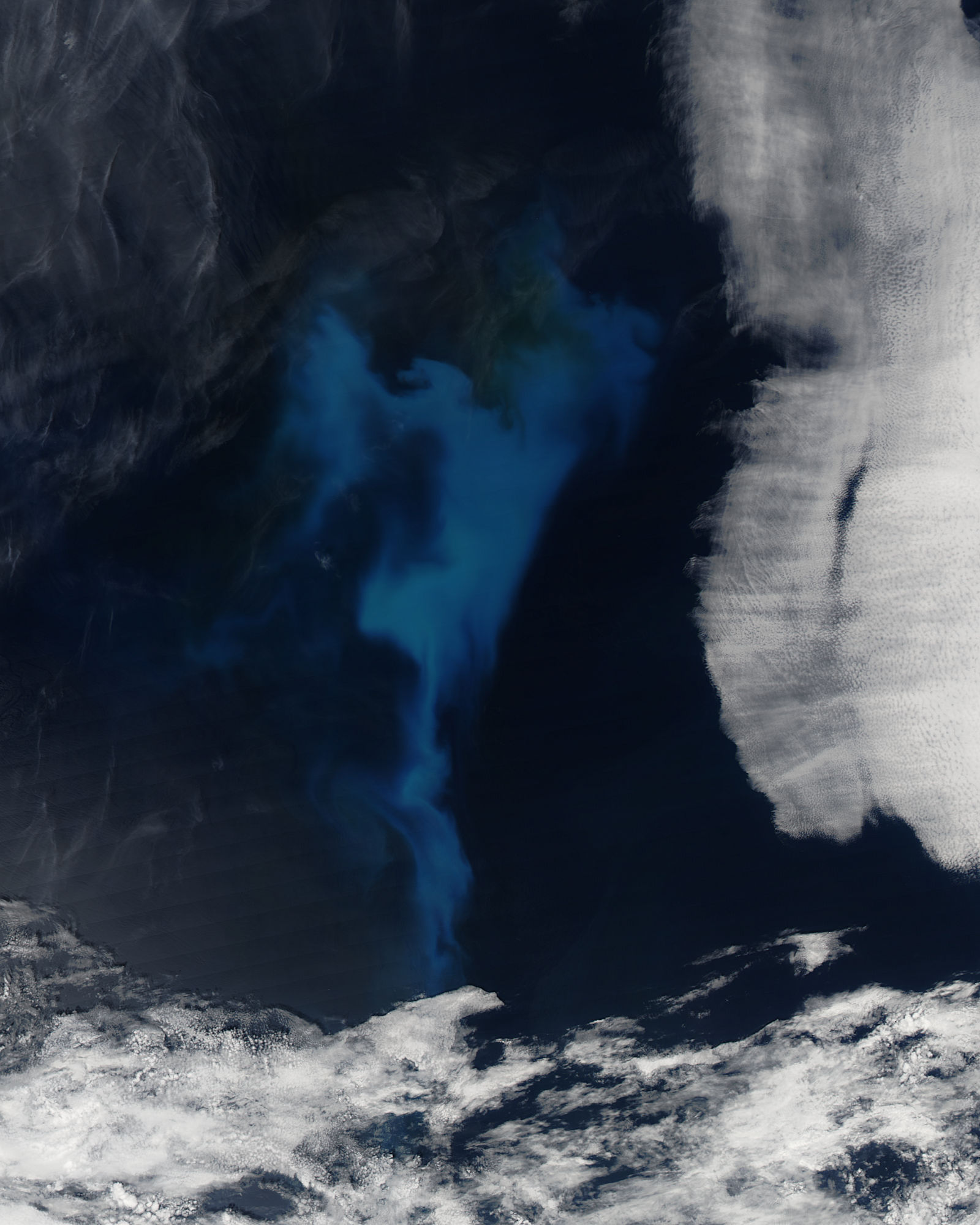
On Saving Planets: Oceans hub · PACE: ocean color and plankton
Free learning resources
- OpenStax Chemistry 2e, Chapter 9: Gases: Gas laws, mixtures and kinetic-molecular theory.
- OpenStax Chemistry 2e, Chapter 11: Solutions and Colloids: Solubility and Henry’s law.
- PhET: Gas Properties: Pump gas, heat it and watch pressure change.
- NOAA: Ocean acidification resources: Lessons, data and labs on CO₂ in seawater.
Unit 5 · Weeks 13–14
Thermodynamics
Chemical energy: heat, enthalpy, why some reactions release energy, and a first look at entropy and Gibbs free energy.
Learning objectives
By the end of this unit you can:
- Use q = mcΔT and calorimetry to find heat flow and specific heat.
- Classify processes as exothermic or endothermic and give the sign of ΔH.
- Use Hess’s law and standard enthalpies of formation to find ΔH of a reaction.
- State the first law of thermodynamics with the chemistry sign convention.
- Use ΔG = ΔH − TΔS to judge whether a process is spontaneous.
Key concepts
- Energy is conserved (the first law): ΔU = q + w. In chemistry, q is heat added to the system and w is work done on the system.
- Exothermic reactions release heat to the surroundings (ΔH < 0); endothermic reactions absorb heat (ΔH > 0).
- Specific heat c is the heat needed to warm 1 g by 1 °C. Water’s is high, 4.184 J/(g·°C), which is why oceans and lakes warm and cool slowly.
- Enthalpy is a state function, so ΔH depends only on start and end. That is why Hess’s law works: you can add reactions and add their ΔH values.
- Standard enthalpy of formation (ΔH°f) is the enthalpy change to make 1 mol of a compound from its elements in their standard states. For an element in its standard state, ΔH°f = 0.
- Entropy (S) measures how spread out energy and matter are. The Gibbs free energy change, ΔG = ΔH − TΔS, is negative for a spontaneous process at constant temperature and pressure.
Key equations
Worked examples, step by step
Example 5.1 How much heat does it take to warm 250.0 g of water from 20.0 °C to 100.0 °C?
Show the steps
- ΔT = 100.0 − 20.0 = 80.0 °C.
- q = mcΔT = 250.0 g × 4.184 J/(g·°C) × 80.0 °C = 83,680 J.
- In kilojoules: 83.7 kJ.
Answer: 83.7 kJ.
Example 5.2 Find ΔH° for burning methane, CH₄(g) + 2 O₂(g) → CO₂(g) + 2 H₂O(l), using ΔH°f values: CH₄(g) −74.6, CO₂(g) −393.5, H₂O(l) −285.8 kJ/mol; O₂(g) 0.
Show the steps
- Products: −393.5 + 2 × (−285.8) = −965.1 kJ.
- Reactants: −74.6 + 2 × 0 = −74.6 kJ.
- ΔH° = −965.1 − (−74.6) = −890.5 kJ.
Answer: About −890 kJ per mole of methane: strongly exothermic.
Example 5.3 Compare the heat released per gram by methane and by hydrogen. For H₂(g) + ½ O₂(g) → H₂O(l), ΔH° = −285.8 kJ.
Show the steps
- Methane: 890.5 kJ ÷ 16.04 g = 55.5 kJ/g.
- Hydrogen: 285.8 kJ ÷ 2.016 g = 141.8 kJ/g.
- Products: methane makes CO₂; hydrogen makes only water.
Answer: Hydrogen releases about 2.6 times more heat per gram, and burning it makes no CO₂. Whether hydrogen is clean overall depends on how it was produced.
Example 5.4 A reaction has ΔH = +40.0 kJ and ΔS = +120 J/K. Is it spontaneous at 298 K? Above what temperature does it become spontaneous?
Show the steps
- Use the same units: ΔS = 0.120 kJ/K.
- At 298 K: ΔG = 40.0 − 298 × 0.120 = 40.0 − 35.8 = +4.2 kJ. Positive, so not spontaneous.
- Set ΔG = 0: T = ΔH/ΔS = 40.0 ÷ 0.120 = 333 K.
Answer: Not spontaneous at 298 K; spontaneous above about 333 K (60 °C).
Practice problems
Work each on paper first, then check.
How much heat raises 1.00 kg of water by 10.0 °C?
Show answer
q = 1000 g × 4.184 × 10.0 = 41,840 J = 41.8 kJ.
Is melting ice endothermic or exothermic? What is the sign of q for the ice?
Show answer
Endothermic; q is positive because the ice absorbs heat.
A 50.0 g metal at 100.0 °C is dropped into 100.0 g of water at 20.0 °C. Both end at 22.0 °C. Find the metal’s specific heat.
Show answer
Heat gained by water = 100.0 × 4.184 × 2.0 = 836.8 J. Metal: 836.8 = 50.0 × c × 78.0, so c = 0.215 J/(g·°C).
Use Hess’s law: C(s) + O₂ → CO₂, ΔH = −393.5 kJ; CO + ½ O₂ → CO₂, ΔH = −283.0 kJ. Find ΔH for C(s) + ½ O₂ → CO.
Show answer
Reverse the second and add: −393.5 + 283.0 = −110.5 kJ.
What is ΔH°f for O₂(g)?
Show answer
Zero: it is an element in its standard state.
A process has ΔH < 0 and ΔS > 0. When is it spontaneous?
Show answer
At every temperature, because ΔG = ΔH − TΔS is always negative.
Common misconceptions
Myth: Heat and temperature are the same thing.
Actually: Temperature measures average particle energy; heat is energy transferred. A bathtub of warm water holds more heat than a cup of boiling water.
Myth: Exothermic reactions always happen on their own.
Actually: Spontaneity depends on ΔG, which includes entropy. Some exothermic reactions are not spontaneous at high temperatures.
Myth: A spontaneous reaction is a fast one.
Actually: Spontaneous tells you the direction, not the speed. Diamond turning into graphite is spontaneous but far too slow to notice.
Myth: Breaking bonds releases energy.
Actually: Breaking bonds always takes energy. Energy is released when new, stronger bonds form.
Flashcards
q = mcΔT
Heat = mass × specific heat × temperature change.
Exothermic
Releases heat; ΔH < 0.
Endothermic
Absorbs heat; ΔH > 0.
Hess’s law
ΔH of a sum of reactions is the sum of their ΔH values.
ΔH°f of an element
Zero in its standard state.
First law
ΔU = q + w; energy is conserved.
Gibbs energy
ΔG = ΔH − TΔS; negative means spontaneous.
Specific heat of water
4.184 J/(g·°C).
Self-check quiz
How this helps save the planet
Thermochemistry is the accounting behind clean energy. Comparing kilojoules per gram and CO₂ per kilojoule, as in the worked examples, shows why hydrogen made with clean power can cut emissions.
The U.S. Department of Energy notes that hydrogen used in a fuel cell produces only water, and that hydrogen can be made from many sources, including solar and wind power.
Water’s high specific heat lets oceans store huge amounts of heat, which steadies coastal climates for people and wildlife.
On Saving Planets: Sentinel-6B: tracking sea level · Earth Observation hub
Sources: U.S. DOE: Hydrogen fuel basics
Free learning resources
- OpenStax Chemistry 2e, Chapter 5: Thermochemistry: Calorimetry, enthalpy and Hess’s law.
- OpenStax Chemistry 2e, Chapter 16: Thermodynamics: Entropy and Gibbs free energy.
- PhET: Energy Forms and Changes: Watch heat flow between objects.
- MIT OpenCourseWare 3.091 Introduction to Solid-State Chemistry: Free lectures that also cover bonding and energy.
The lab (CHEM 110L)
The lab is the hands-on part of the course, a 1-credit component in a typical college schedule. Here it is free and for practice only.
You put lecture ideas into practice with digital sensors, meters and precision glassware. Do the wet-lab versions only in a supervised school or college lab; each exercise also has a safe home or virtual version.
Safety reference: American Chemical Society: Chemical safety
Lab A: Empirical formula of magnesium oxide
Week 5
Goal: Heat magnesium in air, weigh the product, and work out the simplest whole-number ratio of magnesium to oxygen.
Procedure
- Heat an empty crucible and lid to constant mass; cool and weigh.
- Add a coiled strip of clean magnesium ribbon and weigh again.
- Heat with the lid slightly open so air gets in but smoke does not escape, until the metal no longer glows.
- Cool, add a few drops of water, and heat again gently (this turns any magnesium nitride into the oxide), then heat strongly.
- Cool and weigh. Repeat heating until two weighings agree within 0.002 g.
Data table
| Measurement | Mass (g) |
|---|---|
| Crucible + lid | 25.120 |
| Crucible + lid + Mg | 25.360 |
| Crucible + lid + product | 25.520 |
| Mg (by difference) | 0.240 |
| Oxygen gained | 0.160 |
Sample data for practice only.
Sample calculation
- Moles Mg = 0.240 g ÷ 24.31 g/mol = 9.87 × 10⁻³ mol.
- Moles O = 0.160 g ÷ 16.00 g/mol = 1.00 × 10⁻² mol.
- Divide by the smaller: Mg 1.00, O 1.01, which rounds to 1 : 1.
- Empirical formula: MgO.
Safety
- Burning magnesium gives off very bright light, including ultraviolet. Do not stare at it.
- Use tongs; crucibles stay hot long after they stop glowing.
- Never try this at home: magnesium fires are hard to put out, and water makes them worse.
Home or virtual alternative
- Work the same calculation from a percent composition, as in the final practice set (40.0% C, 6.71% H, 53.3% O gives CH₂O).
- OpenStax Chemistry 2e section 3.2 has more empirical-formula problems with answers.
OpenStax 3.2 Determining Empirical and Molecular Formulas
Planet link: Working out the formula of an unknown compound is a first step in identifying a pollutant, a mineral or a new material.
Lab B: Acid–base titration and dilutions
Week 6
Goal: Find the concentration of a hydrochloric acid solution by titrating it with sodium hydroxide of known concentration.
Procedure
- Rinse the burette with a little of the 0.1000 M NaOH, then fill it and record the starting reading to 0.01 mL.
- Pipet 25.00 mL of the HCl into a flask and add 2–3 drops of phenolphthalein indicator.
- Add NaOH while swirling. Near the end, add it drop by drop.
- Stop at the first faint pink that lasts 30 seconds. Record the final reading.
- Repeat until two trials agree within 0.10 mL. With a pH probe, also plot pH against volume to see the steep jump at the equivalence point.
Data table
| Trial | Initial reading (mL) | Final reading (mL) | NaOH used (mL) |
|---|---|---|---|
| 1 (rough) | 0.50 | 23.10 | 22.60 |
| 2 | 0.20 | 22.65 | 22.45 |
| 3 | 1.05 | 23.52 | 22.47 |
Sample data for practice only. Average the trials that agree (2 and 3).
Sample calculation
- Average NaOH volume: (22.45 + 22.47) ÷ 2 = 22.46 mL = 0.02246 L.
- Moles NaOH = 0.1000 mol/L × 0.02246 L = 2.246 × 10⁻³ mol.
- The reaction is 1 : 1, so moles HCl = 2.246 × 10⁻³ mol.
- Concentration of HCl = 2.246 × 10⁻³ mol ÷ 0.02500 L = 0.08984 M.
Safety
- Wear goggles: NaOH and HCl can injure eyes and skin even when dilute.
- If either touches skin, rinse with plenty of water and tell the instructor.
- Fill the burette below eye level, using a funnel, and remove the funnel before reading.
Home or virtual alternative
- PhET Acid-Base Solutions and pH Scale let you test strong and weak acids and bases with a virtual pH meter.
- Kitchen indicator: red cabbage juice turns red-pink in acids like vinegar and green in bases like baking soda solution. This is qualitative only.
PhET: Acid-Base Solutions · PhET: pH Scale · PhET: Molarity
Planet link: pH is one of the most important water-quality measurements. The U.S. Geological Survey notes that normal rain has a pH of about 5.6 and that water draining from an abandoned coal mine can reach pH 2, acidic enough to kill fish downstream. USGS Water Science School: pH and Water
Lab C: Spectrophotometric analysis of a dye solution
Week 12
Goal: Make a calibration curve from dye standards and use it to find the concentration of an unknown, using the Beer–Lambert law.
Procedure
- Warm up the spectrophotometer for the time in its manual.
- Scan one standard to find the wavelength where the dye absorbs most (λmax).
- Zero the instrument with a cuvette of the blank (the solvent, here water).
- Prepare five standards from a stock solution by dilution (M₁V₁ = M₂V₂).
- Measure each standard’s absorbance at λmax, rinsing the cuvette with the next solution each time. Handle cuvettes by the frosted sides.
- Measure the unknown the same way.
- Plot absorbance (y) against concentration (x), fit a straight line through the origin, and use the slope to find the unknown’s concentration.
Data table
| Standard | Concentration (µM) | Absorbance |
|---|---|---|
| 1 | 2.00 | 0.130 |
| 2 | 4.00 | 0.261 |
| 3 | 6.00 | 0.389 |
| 4 | 8.00 | 0.522 |
| 5 | 10.00 | 0.650 |
| Unknown | ? | 0.455 |
Sample data for practice only, not a published value for any real dye.
Sample calculation
- Slope of the line through the origin: about 0.0650 per µM (for example 0.650 ÷ 10.00 µM).
- With b = 1.00 cm, ε = 0.0650 µM⁻¹ cm⁻¹ = 6.50 × 10⁴ M⁻¹ cm⁻¹.
- Unknown: c = A ÷ (εb) = 0.455 ÷ 0.0650 µM⁻¹ = 7.00 µM.
- Fraction of light the unknown transmits: T = 10^(−0.455) = 0.351, or 35.1%.
Safety
- Wear goggles; many dyes stain skin and clothes.
- Wipe up spills at once and keep liquids away from the instrument.
- Dispose of solutions as your lab instructor directs.
Home or virtual alternative
- PhET Beer’s Law Lab: change concentration, path length and wavelength, and record absorbance to build your own calibration curve.
- Kitchen version: make a series of food-coloring dilutions in identical clear glasses and rank them by eye against a white card. This shows the idea but does not give real absorbance numbers.
PhET: Beer’s Law Lab · PhET: Concentration
Planet link: The same idea helps satellites judge ocean and lake health. NASA’s ocean color missions measure the colors of light leaving the water to estimate chlorophyll, a sign of plankton. NASA Ocean Color
Exam prep practice sets
Time yourself: about 10 minutes per problem. Then compare with the full solutions.
Midterm practice set (Units 1–3)
A hydrogen electron drops from n = 4 to n = 2. Find the wavelength of the light.
Show full solution
- |ΔE| = 2.179 × 10⁻¹⁸ J × (1/4 − 1/16) = 2.179 × 10⁻¹⁸ J × 0.1875 = 4.086 × 10⁻¹⁹ J.
- λ = hc/E = (6.626 × 10⁻³⁴ × 2.998 × 10⁸) ÷ 4.086 × 10⁻¹⁹ = 4.862 × 10⁻⁷ m.
Answer: 486 nm (blue-green).
Write the ground-state configuration of copper (Z = 29).
Show full solution
- The simple filling order predicts [Ar] 4s² 3d⁹, but a full 3d subshell is more stable.
- One 4s electron moves to 3d.
Answer: [Ar] 4s¹ 3d¹⁰, a known exception.
How much CO₂ is produced by burning 1.00 kg of octane (C₈H₁₈, 114.23 g/mol)?
Show full solution
- Balanced: 2 C₈H₁₈ + 25 O₂ → 16 CO₂ + 18 H₂O, so 8 mol CO₂ per mol octane.
- Moles octane = 1000 g ÷ 114.23 g/mol = 8.754 mol.
- CO₂ = 8 × 8.754 = 70.04 mol × 44.01 g/mol = 3,082 g.
Answer: About 3.08 kg of CO₂.
28.0 g of N₂ reacts with 9.00 g of H₂: N₂ + 3 H₂ → 2 NH₃. Find the limiting reactant and the mass of NH₃.
Show full solution
- N₂: 28.0 ÷ 28.02 = 0.999 mol. H₂: 9.00 ÷ 2.016 = 4.46 mol.
- N₂ needs 3 × 0.999 = 3.00 mol H₂; 4.46 mol is available, so N₂ is limiting.
- NH₃ = 2 × 0.999 = 2.00 mol × 17.03 g/mol = 34.0 g.
Answer: N₂ is limiting; 34.0 g NH₃.
Give the shape and polarity of SO₂ and of CCl₄.
Show full solution
- SO₂: S has two bonding groups and one lone pair, so it is bent and the dipoles do not cancel.
- CCl₄: four identical bonds, tetrahedral, dipoles cancel.
Answer: SO₂ bent and polar; CCl₄ tetrahedral and nonpolar.
Rank by boiling point, lowest first: H₂O, He, CH₄.
Show full solution
- He: only weak dispersion, very few electrons.
- CH₄: dispersion forces, more electrons than He.
- H₂O: hydrogen bonding.
Answer: He < CH₄ < H₂O.
Final practice set (all units)
What volume does 88.0 g of CO₂ occupy at 25.0 °C and 1.00 atm?
Show full solution
- n = 88.0 ÷ 44.01 = 2.00 mol.
- V = nRT/P = 2.00 × 0.08206 × 298.15 ÷ 1.00.
Answer: 48.9 L.
How many grams of methane must burn (ΔH = −890.5 kJ/mol) to warm 500.0 g of water from 15.0 °C to 85.0 °C, if all the heat goes into the water?
Show full solution
- q = 500.0 × 4.184 × 70.0 = 146,440 J = 146.4 kJ.
- Moles CH₄ = 146.4 ÷ 890.5 = 0.1644 mol.
- Mass = 0.1644 × 16.04 = 2.64 g.
Answer: 2.64 g of methane.
20.00 mL of sulfuric acid is neutralized by 31.60 mL of 0.1000 M NaOH. Find the acid’s molarity.
Show full solution
- H₂SO₄ + 2 NaOH → Na₂SO₄ + 2 H₂O (two acidic hydrogens).
- Moles NaOH = 0.1000 × 0.03160 = 3.160 × 10⁻³ mol, so moles H₂SO₄ = 1.580 × 10⁻³ mol.
- M = 1.580 × 10⁻³ ÷ 0.02000 L.
Answer: 0.07900 M. A common mistake is to forget the 1 : 2 ratio and get 0.1580 M.
A dye has ε = 1.20 × 10⁴ M⁻¹ cm⁻¹. A sample in a 1.00 cm cuvette reads A = 0.300. Find its concentration.
Show full solution
- c = A ÷ (εb) = 0.300 ÷ (1.20 × 10⁴ × 1.00).
Answer: 2.50 × 10⁻⁵ M.
A compound is 40.0% C, 6.71% H and 53.3% O by mass, with a molar mass of 180.16 g/mol. Find its empirical and molecular formulas.
Show full solution
- In 100 g: C 40.0 ÷ 12.011 = 3.33 mol; H 6.71 ÷ 1.008 = 6.66 mol; O 53.3 ÷ 16.00 = 3.33 mol.
- Divide by 3.33: 1 : 2 : 1, so CH₂O (30.03 g/mol).
- 180.16 ÷ 30.03 = 6.
Answer: Empirical CH₂O; molecular C₆H₁₂O₆ (glucose).
Use Hess’s law to find ΔH for C(s) + ½ O₂ → CO, given C + O₂ → CO₂ (−393.5 kJ) and CO + ½ O₂ → CO₂ (−283.0 kJ).
Show full solution
- Keep the first reaction; reverse the second (+283.0 kJ).
- Add them; CO₂ cancels.
Answer: −110.5 kJ.
For a process with ΔH = −10.0 kJ and ΔS = −50.0 J/K, find the temperature below which it is spontaneous.
Show full solution
- ΔG < 0 when ΔH − TΔS < 0. Both are negative, so it works at low T.
- T = ΔH/ΔS = −10.0 kJ ÷ −0.0500 kJ/K = 200 K.
Answer: Spontaneous below 200 K.
Formula sheet
Constants
| Constant | Value |
|---|---|
| Planck constant, h | 6.62607015 × 10⁻³⁴ J·s (exact) |
| Speed of light, c | 2.99792458 × 10⁸ m/s (exact) |
| Avogadro constant, N_A | 6.02214076 × 10²³ mol⁻¹ (exact) |
| Gas constant, R | 8.314 J/(mol·K) = 0.08206 L·atm/(mol·K) |
| Hydrogen energy constant, k | 2.179 × 10⁻¹⁸ J |
| Specific heat of water | 4.184 J/(g·°C) |
| Standard pressure | 1 atm = 101.325 kPa = 760 mmHg |
| Absolute zero | 0 K = −273.15 °C |
Periodic table
Use one of these free interactive tables alongside the course.
- PubChem Periodic Table (U.S. National Library of Medicine): Interactive, with data for every element.
- Ptable: Fast interactive table with orbitals, isotopes and trends.
- NIST Periodic Table of the Elements: Printable reference table from the U.S. standards agency.
Glossary
- Absorbance
- How much light a sample absorbs; A = −log₁₀T.
- Avogadro’s number
- 6.02214076 × 10²³, the number of particles in one mole.
- Calorimetry
- Measuring heat flow from temperature changes.
- Electron configuration
- The arrangement of an atom’s electrons in orbitals.
- Empirical formula
- The simplest whole-number ratio of atoms in a compound.
- Endpoint
- The point in a titration where the indicator changes color.
- Enthalpy (H)
- Heat content of a system at constant pressure.
- Entropy (S)
- A measure of how spread out energy and matter are.
- Equivalence point
- The point where exactly enough titrant has been added to react with the sample.
- Gibbs free energy (G)
- G = H − TS; its change predicts spontaneity.
- Hydrogen bond
- Strong attraction between H on N, O or F and a lone pair on another N, O or F.
- Ideal gas
- A model gas whose particles have no volume and no attractions.
- Isotope
- Atoms of one element with different neutron numbers.
- Limiting reactant
- The reactant that runs out first.
- Molarity
- Moles of solute per liter of solution.
- Mole
- The SI unit for amount of substance.
- Orbital
- A region where an electron is likely to be found.
- Partial pressure
- The pressure one gas in a mixture would exert alone.
- Percent yield
- Actual yield ÷ theoretical yield × 100%.
- Photon
- A particle of light with energy E = hν.
- Quantum numbers
- n, l, mₗ, mₛ: the four values that describe an electron.
- Specific heat
- Heat needed to raise 1 g of a substance by 1 °C.
- Stoichiometry
- The quantitative relationships between amounts in reactions.
- Titration
- Adding a solution of known concentration to find the concentration of another.
- VSEPR
- Valence-shell electron-pair repulsion: electron groups spread out to set molecular shape.
Self-assessment rubric
No grade or credit is given. Use this to judge honestly where you are in each unit.
| Level | What it looks like |
|---|---|
| 4 · Mastery | Solves new, unseen problems correctly, explains why each step works, and catches their own errors. |
| 3 · Proficient | Solves the practice problems with correct units and significant figures; occasional slips. |
| 2 · Developing | Follows worked examples but gets stuck on new problems or mixes up units. |
| 1 · Beginning | Recognizes the terms but cannot yet set up the calculations. |
Suggested weighting if you want a score
| Part | Weight |
|---|---|
| Practice problems | 30% |
| Lab write-ups (or virtual labs) | 20% |
| Midterm practice set | 20% |
| Final practice set | 30% |
Aim for level 3 or better in every unit before moving to the next course.