Enceladus
Saving moons: a small ice world that sprays its hidden ocean into space.
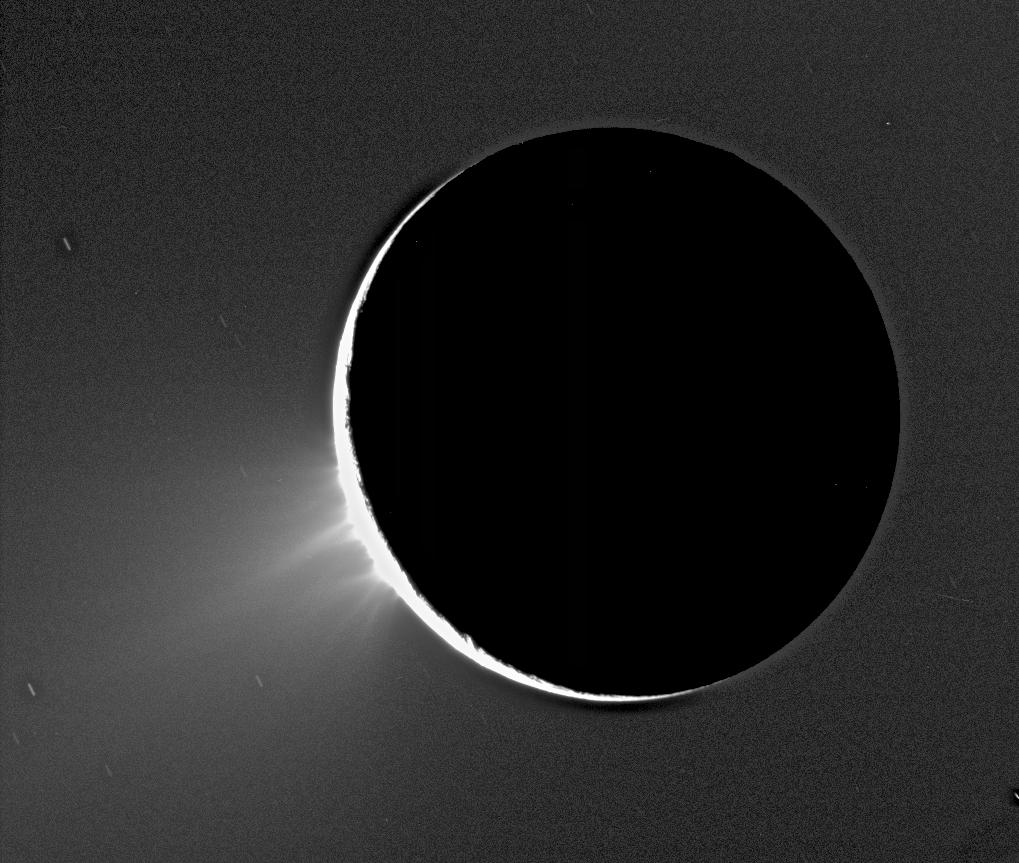
Image: NASA/JPL/Space Science Institute (PIA11688).
Last reviewed: 20 sources cited
Impact Statement
A handful of worlds are thought to hide liquid water oceans under their ice, but Enceladus sprays its ocean out into space, where a spacecraft can sample it. From those samples, scientists have found most of the chemical ingredients needed for life, and signs of hydrothermal vents releasing hot, mineral-rich water into the ocean.
Source: NASA, Enceladus
To be clear: no one has found life on Enceladus, and Cassini was not built to detect it. What Enceladus offers is a natural laboratory for asking whether life could begin in an ocean far from the Sun, with seafloor vents not unlike the ones that dot Earth’s ocean floor.
Source: NASA, new insights into ocean worlds (2017)
Source: NASA, Enceladus
The Five W's of Enceladus
Who
NASA’s Cassini spacecraft studied Enceladus up close while it orbited Saturn from 2004 to 2017. Next, ESA is studying a mission called L4 to land on the moon, and the U.S. planetary science decadal survey recommends a NASA Enceladus Orbilander.
Source: NASA, Cassini
Source: ESA, L4 to Enceladus
Source: National Academies, planetary science decadal survey (2022)
What
A small, icy moon about 500 km (310 miles) across, roughly as wide as Arizona, with a global ocean of liquid water under its ice shell and geyser-like jets of water vapor and ice at its south pole.
Source: NASA, Enceladus
Source: NASA, Cassini finds global ocean in Enceladus (2015)
When
William Herschel discovered Enceladus on August 28, 1789. Cassini found the jets in 2005, confirmed the global ocean in 2015, and ended its mission on September 15, 2017.
Source: NASA, Enceladus
Source: NASA, Cassini finds global ocean in Enceladus (2015)
Source: NASA, Cassini
Where
Enceladus orbits Saturn about 238,000 km (148,000 miles) from the planet, between the moons Mimas and Tethys, inside the densest part of Saturn’s E ring. One The curved path an object takes as it travels around a planet, moon or star, like a satellite circling Earth. Glossary takes 32.9 hours.
Source: NASA, Enceladus
Why
A global ocean, unusual chemistry and internal heat make Enceladus one of the most promising places in the solar system to look for a world where life could exist.
Source: NASA, Enceladus
The Hidden Ocean

A Wobble Gave It Away
Cassini measured a very slight wobble, or libration, as Enceladus orbits Saturn. The wobble is too large for a moon frozen solid, so the icy crust must float on a global ocean (2015, journal Icarus).
Source: NASA, Cassini finds global ocean in Enceladus (2015)
Source: NASA Photojournal, Global Ocean on Enceladus (PIA19656)
Thin Ice at the Pole
The ice shell may be only 1 to 5 km (half a mile to 3 miles) thick at the south pole, and about 20 to 25 km (12 to 16 miles) thick on average.
Source: NASA, Enceladus
Tidal Heating
Enceladus orbits Saturn twice for every orbit of the larger moon Dione. Dione’s gravity stretches Enceladus’ orbit into an ellipse, and the changing pull of Saturn heats the moon from inside.
Source: NASA, Enceladus
Hot Water and Rock
Saturn’s E ring contains tiny grains of silica that can only form where liquid water and rock interact above about 90 °C (200 °F). This points to hydrothermal vents deep under the ice.
Source: NASA, Enceladus
Brightest Surface
Enceladus is the most reflective body in the solar system. Because it reflects so much sunlight, its surface is about −201 °C (−330 °F).
Source: NASA, Enceladus
What Cassini Found in the Plumes

Jets at 400 m/s
In 2005 Cassini discovered water vapor and ice particles gushing from the surface at about 400 meters per second (800 mph). The eruptions appear to be continuous. Most of the material falls back like snow; some feeds Saturn’s E ring.
Source: NASA, Enceladus
Source: NASA Photojournal, Fountains of Enceladus (PIA07758)
Tiger Stripes
The jets come from relatively warm fractures near the south pole, informally called “tiger stripes.” The four main stripes are each about 135 km (84 miles) long.
Source: NASA, Enceladus
Source: NASA Photojournal, the geyser basin of Enceladus (PIA11688)
Water, and Hydrogen
On its deepest dive through the plume, on Oct. 28, 2015, Cassini found the gas is nearly 98% water and about 1% hydrogen, plus A gas that people and animals breathe out and that burning fuel releases. Plants take it in, and too much of it in the air warms the planet. Glossary, A greenhouse gas that traps much more heat than carbon dioxide over a few decades. It leaks from oil and gas sites, landfills and farms. Glossary and ammonia. Hydrogen from hot water reacting with rock could be a chemical energy source for microbes (2017).
Source: NASA, new insights into ocean worlds (2017)
Source: NASA Photojournal, Enceladus Hydrothermal Activity (PIA21442)
Complex Organics
In 2018 scientists reported large, complex organic molecules in ice grains from the plume, the first such detection from an extraterrestrial water world. Organic material in the plume was about 20 times denser than expected.
Source: NASA Astrobiology, complex organics bubble up from Enceladus (2018)
Source: NASA, Enceladus
Phosphorus
In 2023 Cassini data revealed sodium phosphates in ice grains from Enceladus. Phosphorus, an essential element for life, was found in an ocean beyond Earth for the first time, at least 100 times more concentrated than in Earth’s oceans.
Source: NASA, building block for life in Enceladus’ ocean (2023)
Fresh From the Ocean
A 2025 study of grains collected in 2008, just 21 km above the surface at about 18 km/s, found new organic molecules in ice minutes old, fresh from the ocean, a step toward confirming active organic chemistry below the ice.
Source: NASA, organics fresh from the ocean of Enceladus (2025)


Future Missions
ESA L4
ESA’s fourth Large-class mission, under study, the first flagship mission of its Voyage 2050 plan. It would sample the plumes and land on Enceladus to look for the ingredients that could fuel life. ESA’s current timeline: adoption around 2034, launch around 2042, arrival at Saturn in 2053 and landing in 2058.
Source: ESA, L4 to Enceladus
Source: ESA, L4 timeline and status
Enceladus Orbilander
The 2022 U.S. planetary science decadal survey says the Orbilander should be NASA’s second-highest-priority large mission. It would search for evidence of life from orbit and during a two-year landed mission studying fresh plume material. It is a recommendation, not an approved mission.
Source: National Academies, planetary science decadal survey (2022)


Want to go deeper? NASA’s Enceladus page has the latest science, images and the Ocean Worlds resource package.
 For further information
Related Solutions
More solutions like this one, matched by meaning.
Help This Work
NASA doesn't take donations, but anyone can join one of its citizen science projects.