Want to go deeper? NASA's Dragonfly page has the mission plan, rotorcraft details, and the latest news.
 For further information
Saving moons: a prebiotic time capsule, and the rotorcraft built to open it.
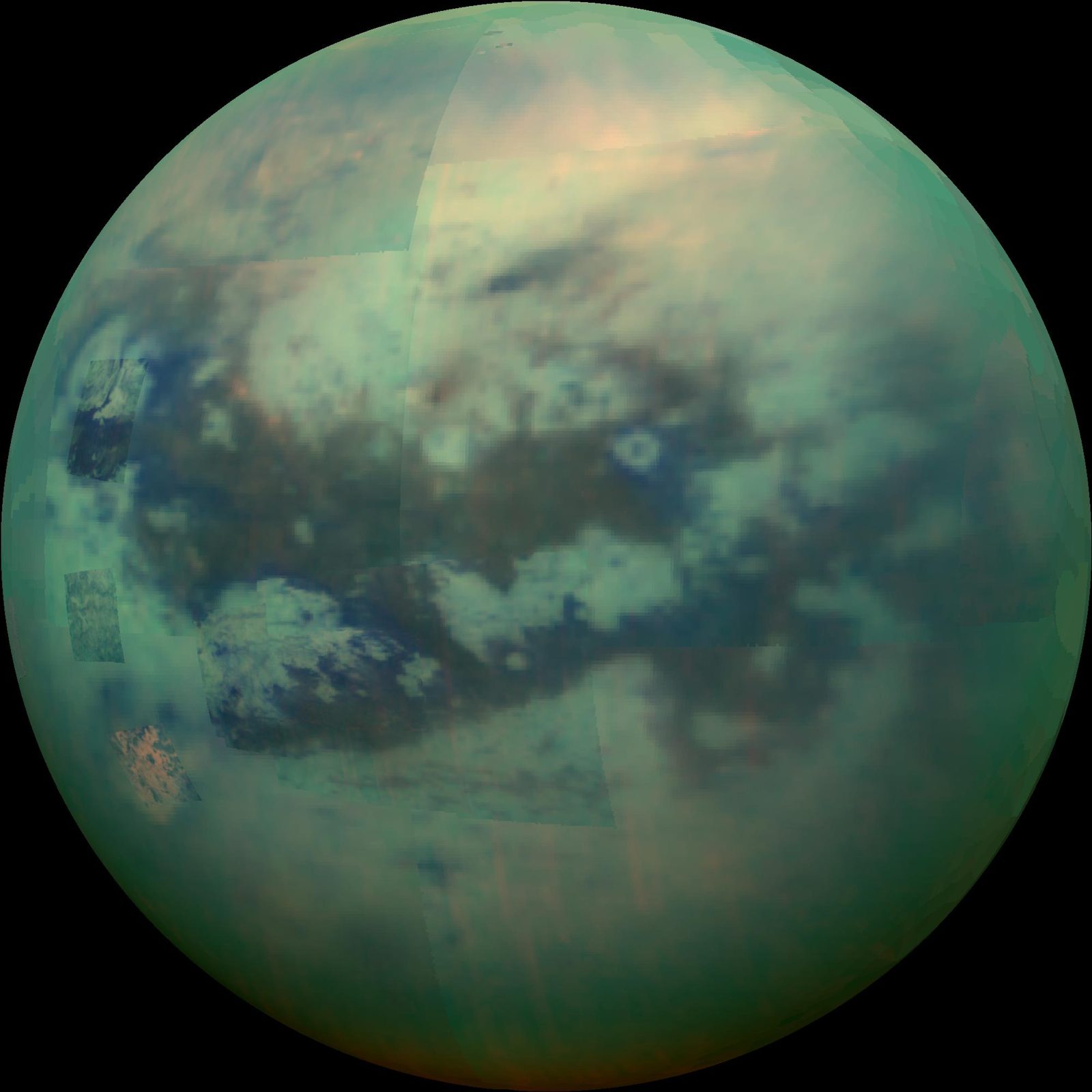
Image: NASA/JPL/University of Arizona/University of Idaho. Cassini VIMS infrared mosaic, “Peering Through Titan's Haze” (PIA20016).
Titan is a prebiotic time capsule. Like Earth, its atmosphere is mostly nitrogen, and NASA describes Titan as an analog to the very early Earth that can offer clues to how life may have arisen here. Dragonfly “isn't a mission to detect life,” NASA says. It is a mission to investigate the chemistry that came before biology.
Source: NASA Astrobiology, Dragonfly selection
Source: NASA, Dragonfly
To be honest about it: Dragonfly does not remove a single piece of debris. It belongs in Project Rawane because the Earth-space relationship runs both ways. The tools we build to explore other worlds come home as the tools we use to protect this one.
Radar that sees through haze. Cassini's radar was built mainly for Titan, bouncing radio waves off the surface to see lakes, mountains and dunes below the haze. On Earth, the synthetic aperture radar on ESA's Sentinel-1 sees through clouds, rain and darkness, which makes it useful for mapping floods and tracking oil slicks. It is the same family of technique, not the same instrument.
Source: NASA, Cassini RADAR
Source: ESA, Sentinel-1 emergency response
Power where sunlight is scarce. Titan's haze rules out solar power, so Dragonfly carries a Multi-Mission Radioisotope Thermoelectric Generator (MMRTG), like the one on NASA's Curiosity rover. Radioisotope power runs continuously for years, largely independent of sunlight, dust or thick clouds, and it also powers Perseverance, Voyager and New Horizons.
Source: Johns Hopkins APL, What Is Dragonfly?
Source: NASA, Radioisotope Power Systems
Autonomy when help is far away. Earth is 8 to 11 AU from Titan, so a radio signal takes about 70 to 90 minutes one way. Nobody can steer Dragonfly in real time, so it flies and runs science operations autonomously. Closer to home, ESA is developing automated collision avoidance that assesses risk and could even command satellites to dodge debris on their own. Different machines, same idea: let the spacecraft make safe decisions when humans can't react in time.
NASA, with the Johns Hopkins Applied Physics Laboratory (APL) in Laurel, Maryland designing, building and managing the mission. Principal investigator: Elizabeth “Zibi” Turtle of APL.
Source: NASA, Dragonfly
Dragonfly, a car-sized rotorcraft lander with eight rotors, the first of its kind to explore another world. It will hop between sites, sampling surface material to study how far prebiotic chemistry has progressed.
Source: NASA, Dragonfly
Launch period July 5 to 25, 2028, on a SpaceX Falcon Heavy from Kennedy Space Center. Arrival at Titan in late 2034, followed by a planned 3.3-year mission.
Source: NASA, launch services contract
Source: NASA, Dragonfly
Titan, Saturn's largest moon. Saturn is about 1.4 billion km (9.5 AU) from the Sun. Dragonfly will land in the equatorial Shangri-La dune fields and work its way toward Selk crater.
Source: NASA, Titan Facts
Source: NASA Astrobiology
Titan is a prebiotic time capsule, a natural lab for the chemistry that came before biology. Getting there builds humanity's toolkit of radar, long-life power and autonomy, the same kinds of tools we use to watch over and protect Earth.
Source: NASA, Dragonfly
The second-largest moon in the solar system, after Jupiter's Ganymede (by just 2%). Titan is bigger than the planet Mercury, with a radius of about 2,575 km.
Source: NASA, Titan Facts
The only moon with a dense atmosphere: about 95% nitrogen and 5% methane. Surface pressure is about 60% higher than Earth's, and the atmosphere is about four times denser than Earth's at the surface.
Source: NASA, Titan Facts
Source: Johns Hopkins APL, Why Titan?
The only world besides Earth known to have liquid on its surface. Methane and ethane fall as rain, carve rivers, and fill lakes and seas, in a cycle like Earth's water cycle.
Source: NASA, Titan Facts
Vast dark dunes wrap the equator, made of hydrocarbon grains that may look like coffee grounds. They resemble the linear dunes of Namibia.
Source: NASA, Titan Facts
About −179 °C (−290 °F) at the surface, so cold that water ice plays the role of rock. Sunlight there is about 100 times fainter than at Earth.
Source: NASA, Titan Facts
Cassini gravity data were long read as a global ocean of liquid water under the ice. A 2025 reanalysis led by JPL suggests slushy ice with pockets of liquid water instead. Dragonfly may help settle it.
Source: NASA, Titan Facts
Source: NASA JPL, Titan may not have global ocean
Source: Petricca et al., Nature (2025)
NASA's Cassini orbited Saturn from 2004 to 2017, and its radar mapped Titan's surface through the haze.
Source: NASA, Cassini
Source: NASA, Cassini RADAR
ESA's Huygens probe landed on Titan on January 14, 2005. It is still the only landing in the outer solar system and the most distant landing from Earth.
Source: NASA, Huygens
Source: ESA, Huygens lands on Titan
An impact crater about 50 miles (80 km) wide, where melted ice may have stayed liquid for thousands of years, mixing water with organics.
Eight rotors, one hop every 1 to 2 Titan days (each about 16 Earth days), and a planned flight distance of more than 175 km. The launch contract is valued at about $256.6 million.
Source: NASA, Dragonfly
Source: NASA Astrobiology
Source: NASA, launch services contract
Want to go deeper? NASA's Dragonfly page has the mission plan, rotorcraft details, and the latest news.
For further information