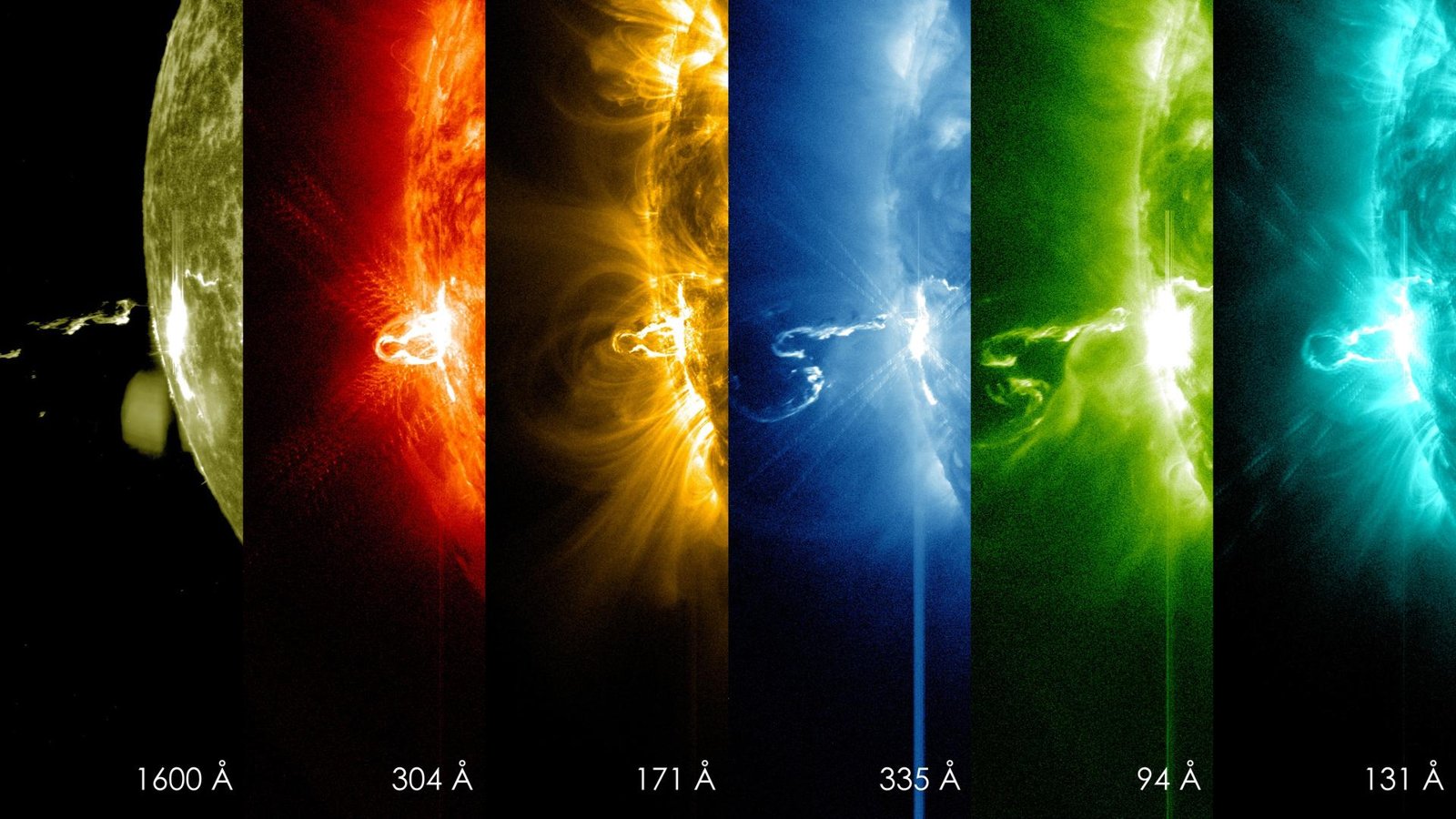
Aditya-L1 (ISRO)
Aditya-L1 is ISRO's first space-based solar observatory, studying the Sun from a halo orbit around L1, about 1.5 million km from Earth.
Earth is protected by layers: the Sun's own bubble, our planet's magnetic field, and the air itself. Space weather is what happens when the Sun pushes on those shields. The missions on this page watch the Sun so power grids, satellites and astronauts get warning in time.
NOAA, ESA and ISRO, plus Earth's natural shields.
Watching the Sun so forecasters can warn about solar storms, and understanding the shields that protect us.
SOLAR-1 entered operations June 10, 2026; Aditya-L1 has observed from L1 since January 2024; Vigil launches in 2031.
Source: NOAA, SOLAR-1 enters operations
Source: ISRO, Halo orbit insertion
Source: ESA, Vigil mission overview
The Sun-Earth L1 and L5 points, and Earth's magnetosphere and atmosphere.
Vigil can give up to four to five days' notice of some space weather effects, protecting power grids, satellites and astronauts.
Source: ESA, Vigil mission overview
Aditya-L1 is ISRO's first space-based solar observatory, studying the Sun from a halo orbit around L1, about 1.5 million km from Earth.
NOAA's SOLAR-1 (formerly SWFO-L1) watches the Sun from L1, about one million miles from Earth, streaming space weather data to forecasters in real time.
Three natural shields protect Earth: the heliosphere, the magnetosphere, and the atmosphere and ozone layer.
ESA's Vigil will watch the Sun from L5, giving up to four to five days' notice of certain space weather effects. Launch is planned for 2031.
Natural solution
The Sun blows a bubble of solar wind around the whole solar system. Voyager 1 crossed its edge, the heliopause, on August 25, 2012, at about 122 AU (about 18 billion km) from the Sun, the first human-made object to reach interstellar space. Voyager 2 followed in 2018.
Source: NASA, Voyager Interstellar Mission
NASA's IMAP launched on September 24, 2025 to the L1 point to map that boundary from afar.
Source: NASA, IMAP launch release
Earth's magnetic field deflects most of the charged solar wind and helps keep it from stripping away our atmosphere. It is not a perfect wall: strong solar storms still get through and drive geomagnetic storms and auroras.
Source: NASA, Earth's magnetosphere
High in the stratosphere, the ozone layer absorbs most of the Sun's biologically harmful UV-B radiation before it reaches the ground.
Source: NOAA, Ozone basics
These shields are free, natural and have run for billions of years. Our job is to understand them and avoid damaging the one we can: the ozone layer.
Agency solution · active
NOAA's SOLAR-1 (formerly SWFO-L1) launched on September 24, 2025 on a Falcon 9, reached the Sun-Earth L1 point, about one million miles from Earth, on January 23, 2026, and entered operational service on June 10, 2026.
Source: NOAA NESDIS, SOLAR-1 reaches L1
Source: NOAA, SOLAR-1 enters operations
It is the first U.S. satellite designed exclusively for continuous, operational space weather observations, streaming solar wind data and coronal mass ejection images to NOAA's Space Weather Prediction Center in real time, free to the public.
Source: NOAA, SOLAR-1 enters operations
Agency solution · active (in development, contracted)
Vigil will watch the Sun from the fifth Lagrange point (L5), seeing the "side" of the Sun and solar activity days before it rotates into view from Earth. ESA says it can give up to four to five days' notice of certain space weather effects, and measure the speed and direction of solar eruptions more clearly.
Source: ESA, Vigil mission overview
ESA signed a €340 million contract with Airbus Defence and Space UK to build it. Launch is planned for 2031 on an Ariane 6, with an expected five years of operations at L5.
Source: ESA, Airbus to build Vigil
Source: ESA, Vigil mission overview
Agency solution · active
India's first space-based solar observatory launched on PSLV-C57 on September 2, 2023 and entered a halo orbit around L1, about 1.5 million km from Earth, on January 6, 2024. From there it watches the Sun without eclipses.
Source: ISRO, Halo orbit insertion
It carries seven payloads: four look directly at the Sun (VELC, SUIT, SoLEXS, HEL1OS) and three measure particles and fields at L1 (ASPEX, PAPA, magnetometer), helping explain coronal mass ejections, flares and space weather.
Source: ISRO, Aditya-L1
Want to go deeper? NOAA's Space Weather Prediction Center posts live solar wind data, including SOLAR-1.
For further information