Want to go deeper? Visit NASA.
 For further information
The heliosphere, the magnetosphere and the ozone layer: free, natural protection.
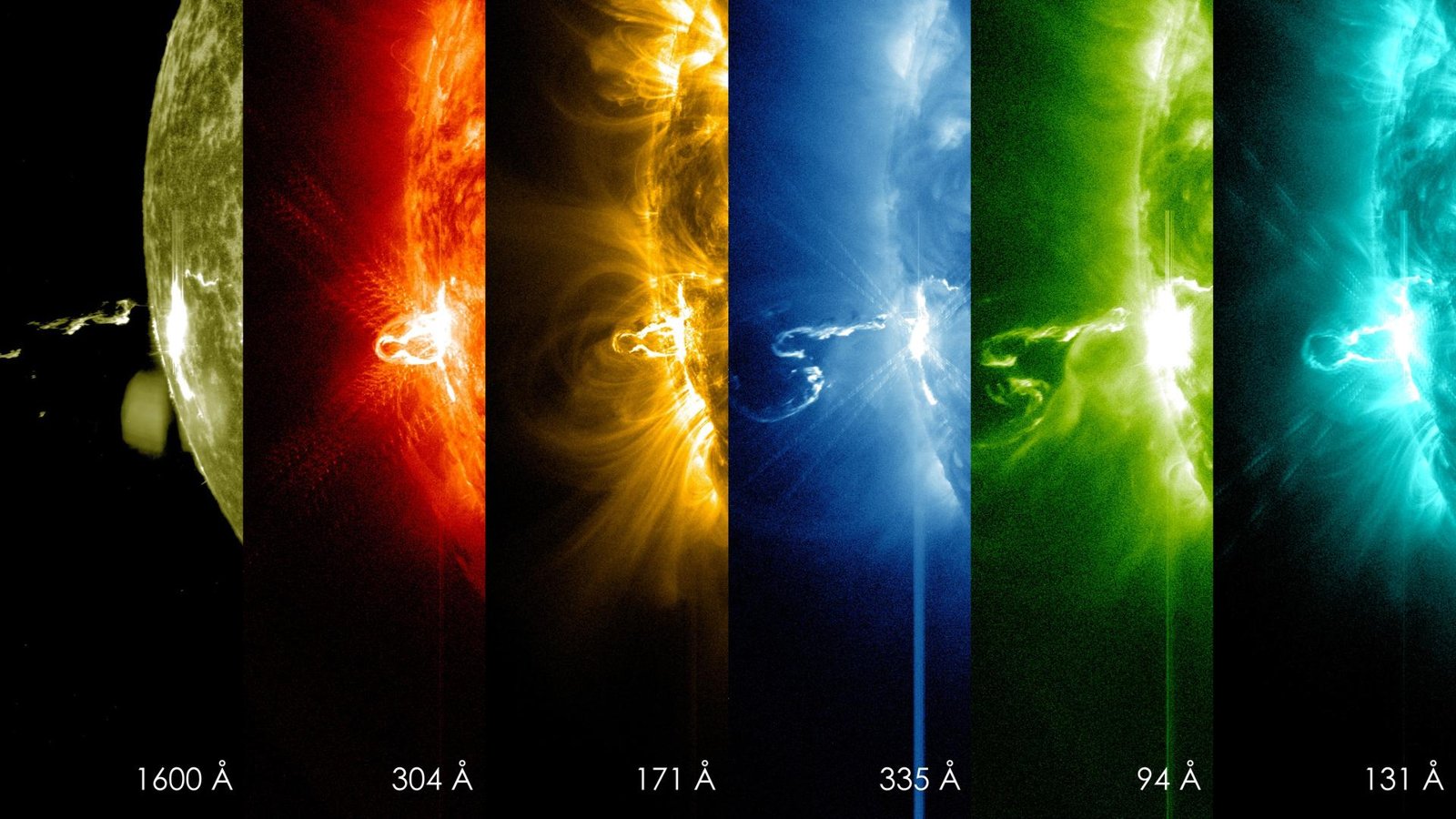
Image: NASA/SDO (Solar Dynamics Observatory), a solar flare seen in six wavelengths.
Natural solution · active
The Sun blows a bubble of solar wind around the whole solar system. Voyager 1 crossed its edge, the heliopause, on August 25, 2012, at about 122 AU (about 18 billion km) from the Sun, the first human-made object to reach interstellar space. Voyager 2 followed in 2018.
Source: NASA, Voyager Interstellar Mission
NASA's IMAP launched on September 24, 2025 to the L1 point to map that boundary from afar.
Source: NASA, IMAP launch release
Earth's magnetic field deflects most of the charged solar wind and helps keep it from stripping away our atmosphere. It is not a perfect wall: strong solar storms still get through and drive geomagnetic storms and auroras.
Source: NASA, Earth's magnetosphere
High in the stratosphere, the ozone layer absorbs most of the Sun's biologically harmful UV-B radiation before it reaches the ground.
Source: NOAA, Ozone basics
These shields are free, natural and have run for billions of years. Our job is to understand them and avoid damaging the one we can: the ozone layer.
Nature itself: the Sun, Earth's magnetic field and our atmosphere. No organization runs them.
Three layers of protection: the heliosphere, the magnetosphere, and the atmosphere with its ozone layer.
Running for billions of years, and still working today.
From the edge of the solar system (about 122 AU for Voyager 1's crossing) down to Earth's stratosphere.
They deflect the solar wind and absorb most harmful UV-B. The ozone layer is the one we can damage, so it is the one we must protect.
Source: NOAA, Ozone basics
Want to go deeper? Visit NASA.
For further information