Want to go deeper? NASA's Jupiter overview has images, missions, and the latest science.
 For further information
A natural debris-removal system, four and a half billion years in the making.
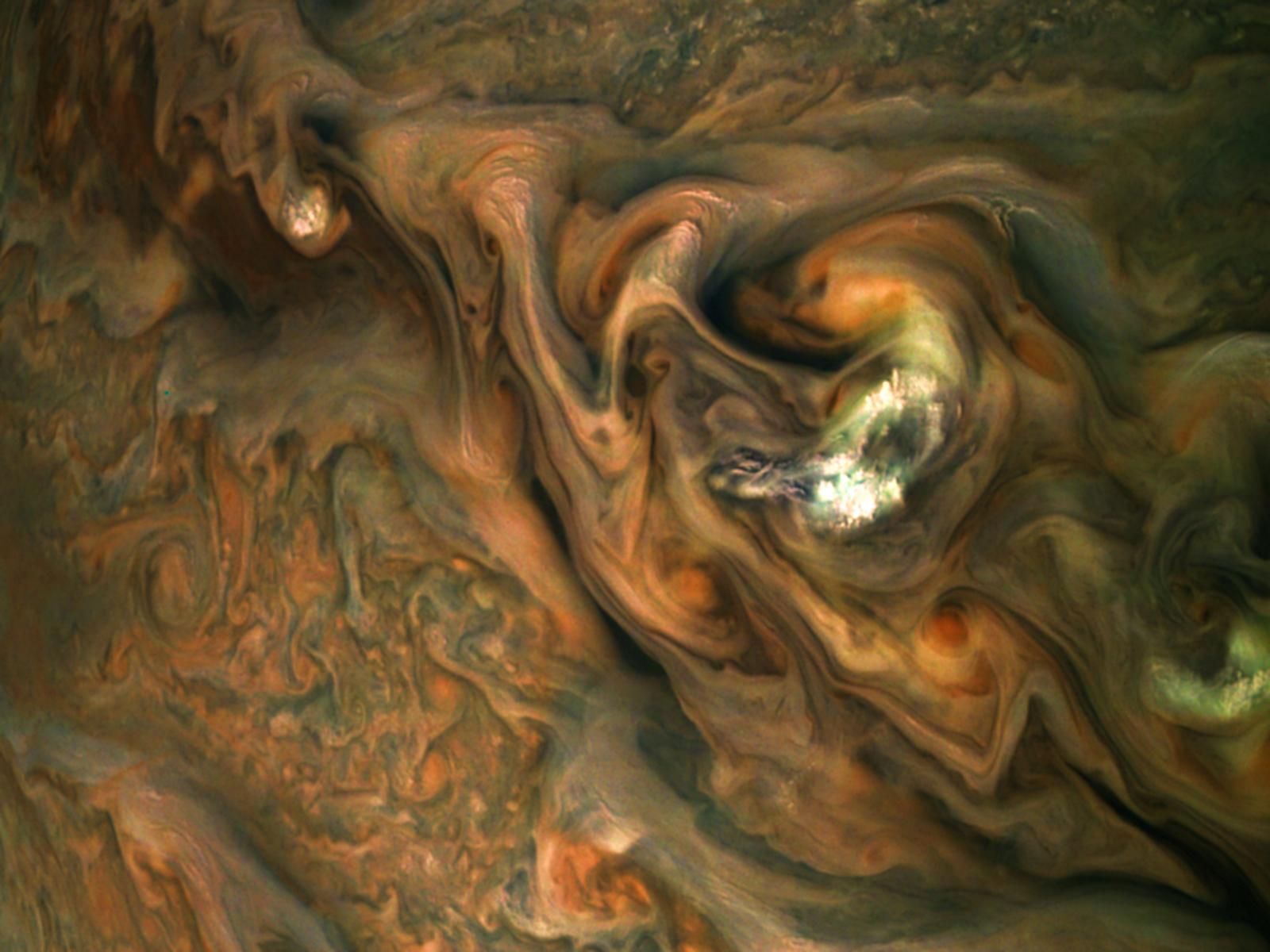
Image: NASA / JPL-Caltech / SwRI / MSSS, enhanced color by Kevin Gill. JunoCam, July 10, 2017 (PIA21395).
Jupiter is the most active debris-removal system we know. Comet impacts are thought to happen over 2,000 times more often on Jupiter than on Earth. Modeling suggests objects about 10 meters across hit Jupiter around 12 to 45 times per year, compared with about once every 6 to 15 years on Earth.
Source: The Planetary Society, Does Jupiter protect Earth from asteroids and comets?
For long-period comets falling in from the distant Oort Cloud, Jupiter is a clear shield, flinging many away before they reach us. For asteroids and short-period comets, its gravity can also nudge objects onto orbits that cross Earth's. Simulations by Horner and Jones found that a giant planet can significantly increase the asteroid impact rate on Earth, so the picture is far less clear-cut than "Jupiter protects us."
Source: The Planetary Society
Source: Horner & Jones (2008), Jupiter: friend or foe? I: the asteroids
So Jupiter is a natural cleanup crew with real trade-offs. Scientists are still honest about both sides, and so are we.
Jupiter itself. No organization, no crew, no budget. The planet does the work.
A natural debris-removal and deflection system. Its gravity captures or ejects asteroids and comets that would otherwise cross the inner solar system, and it shapes orbits across the whole neighborhood.
Ongoing since the planet formed with the rest of the solar system, about 4.6 billion years ago.
Source: NASA, Jupiter Facts
The fifth planet from the Sun, about 5.2 AU out (778 million km), sitting between the asteroid belt and the outer solar system.
Source: NASA Jupiter Fact Sheet
Space and Earth are one system. A planet that intercepts hazards before they reach us is doing planetary defense without a single rocket launch.
Equatorial diameter of about 142,984 km (2 × 71,492 km radius), roughly 11 times wider than Earth.
Source: NASA Fact Sheet
Source: NASA, Jupiter Facts
About 1,321 Earths would fit inside it, and it has 318 times Earth's mass.
Source: NASA Jupiter Fact Sheet
At the equatorial cloud tops, gravity is about 2.4 times Earth's (23.12 vs 9.78 m/s²).
Source: NASA Jupiter Fact Sheet
The shortest day in the solar system, about 9.9 hours. One orbit of the Sun takes 11.86 Earth years.
Source: NASA, Jupiter Facts
Source: NASA Fact Sheet
About 90% hydrogen and 10% helium by volume (89.8% and 10.2%), similar to the Sun.
Source: NASA Jupiter Fact Sheet
NASA's Juno mission found the core is not a small solid ball but partially dissolved into the surrounding metallic hydrogen, a dilute or “fuzzy” core. A 2025 modeling study finds today's Jupiter is best explained by a metal-rich dilute core inherited from formation.
Source: NASA, Jupiter Facts (Juno)
Source: Knierim et al., arXiv:2512.03961
115 moons officially recognized by the International Astronomical Union.
Source: NASA, Jupiter Moons
Io, Europa, Ganymede and Callisto, discovered by Galileo in 1610, were the first moons found beyond Earth's. Ganymede is the largest moon in the solar system, bigger than Mercury. Io is the most volcanically active body in the solar system. Europa may hide a liquid-water ocean beneath its icy crust.
Source: NASA, Jupiter Moons
A giant storm bigger than Earth that has been observed for more than 300 years. Juno found it reaches roughly 500 km below the cloud tops.
Source: NASA, Jupiter Facts
Want to go deeper? NASA's Jupiter overview has images, missions, and the latest science.
For further information