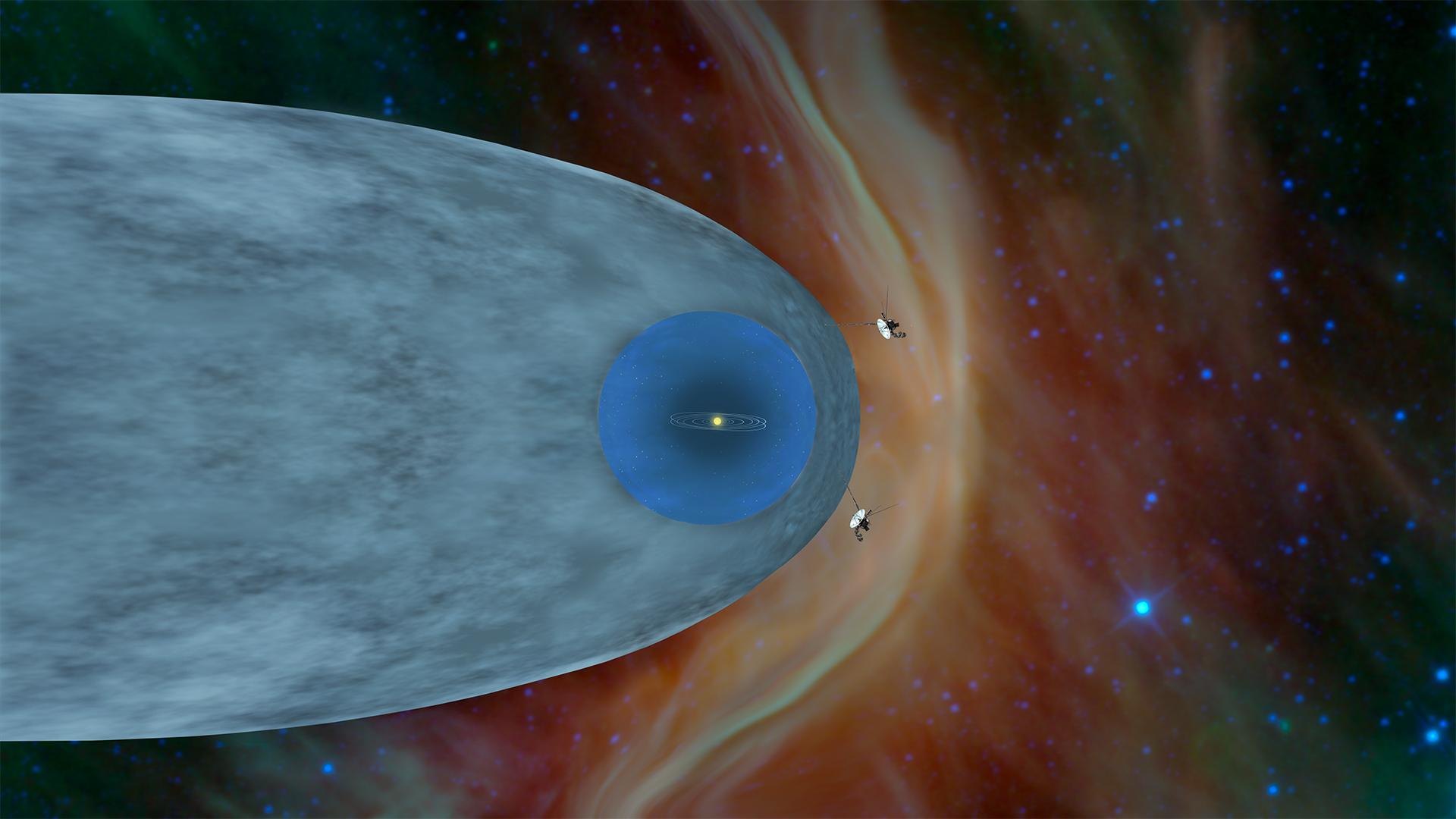
Voyager 1 and 2 (NASA)
Launched in 1977, the twin Voyagers are in interstellar space, and on Nov. 18, 2026, Voyager 1 will be one light-day from Earth (NASA).
Image: NASA/JPL-Caltech (PIA22835).
Last reviewed: 3 sources cited
Explain Like I'm 10
- Voyager 1 and Voyager 2 are two spacecraft that left Earth in 1977.
- They flew past the giant planets and are now outside the bubble the Sun makes around itself.
- On Nov. 18, 2026, Voyager 1 will be so far away that its radio signal takes a whole day to reach us.
The Five W's of Voyager
Who
NASA. Five science investigation teams use the spacecraft, which still have four operating instruments between them.
Source: NASA, Voyager mission overview
What
Twin robotic spacecraft. Their main mission explored Jupiter and Saturn; Voyager 2 then went on to Uranus and Neptune.
Source: NASA, Voyager mission overview
When
Voyager 2 launched on Aug. 20, 1977, and Voyager 1 on Sept. 5, 1977, both from Cape Canaveral, Florida.
Source: NASA, Voyager mission overview
Where
In interstellar space, the region between stars. Voyager 1 crossed into it in August 2012 and Voyager 2 on Nov. 5, 2018.
Source: NASA, Voyager mission overview
Why
The Voyager Interstellar Mission extends exploration to the outer limits of the Sun's sphere of influence, and possibly beyond.
Source: NASA, Voyager mission overview
Impact Statement
Agency solution · active
On Nov. 18, 2026, at 2:16:07 a.m. PST, Voyager 1 will be 16.094 billion miles (25.902 billion km) from Earth, the distance light travels in 24 hours (NASA).
Source: NASA, Where are Voyager 1 and Voyager 2 now?
For Further Information: NASA, Where are Voyager 1 and Voyager 2 now?
To stretch their power, engineers have switched off instruments one by one; Voyager 1's cameras have been off since 1990 (NASA).
How This Saves People & the Planet
For People
Voyager's discoveries, from active volcanoes on Jupiter's moon Io to details of Saturn's rings, are shared knowledge for everyone (NASA).
Source: NASA, Voyager mission overview
For Nature
Voyager studies the heliosphere, the bubble the Sun blows around our solar system, which surrounds Earth and all life on it (NASA).
Source: NASA, Voyager mission overview
Get Involved With Voyager
Want to go deeper? NASA has the full Voyager story.
 For Further Information
Related Solutions
More solutions like this one, matched by meaning.
Help This Work
Links go straight to the organization. Saving Planets doesn't receive any of the money.