
Physics I + Lab
Calculus-based mechanics: motion, forces, energy, momentum, rotation, orbits, oscillations and fluids, with eight labs. Free, self-paced, and tied to real planet-saving work.
Courses › PHYS 110 + PHYS 110L
About this course
This is a free self-study course outline written by Saving Planets. It is not a university course, it carries no academic credit, and no school is involved.
Its scope follows the first semester of calculus-based college physics (classical mechanics), the course every engineering and physics major takes first. It is modeled on the topics and depth of open materials such as OpenStax University Physics Volume 1 and MIT OpenCourseWare 8.01SC Classical Mechanics, which we link to throughout. Those organizations do not endorse this page.
What we add: every unit is tied to real aerospace and Earth-observation work, every number on the page is re-computed by a checking script before it goes live, and every lab has a home or virtual version so anyone can do it.
Work through it in order. Each unit has goals, key ideas, equations, step-by-step examples, practice with full answers, common mistakes, flashcards and a quiz. Your progress is saved only in this browser.
How this course helps save the planet
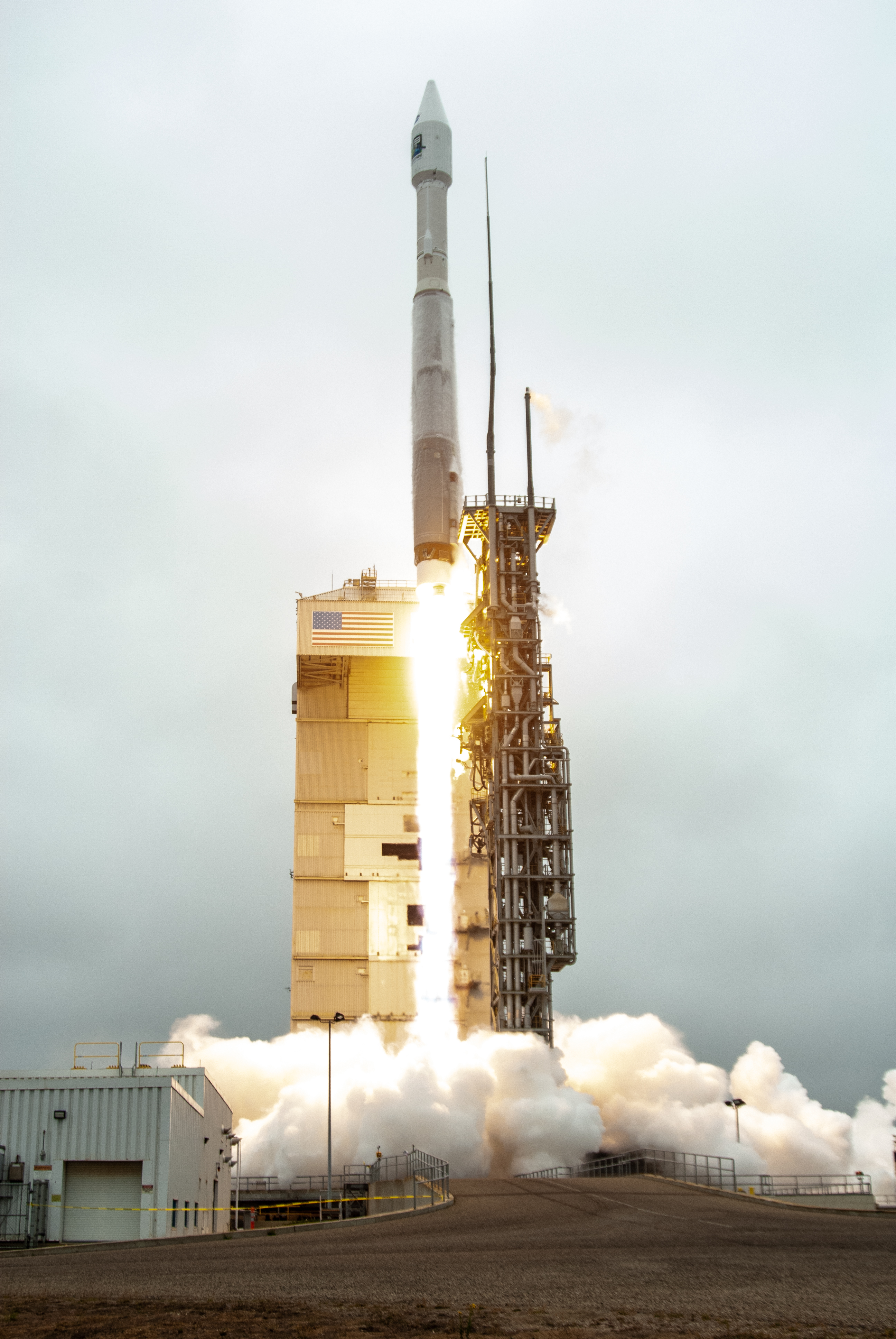
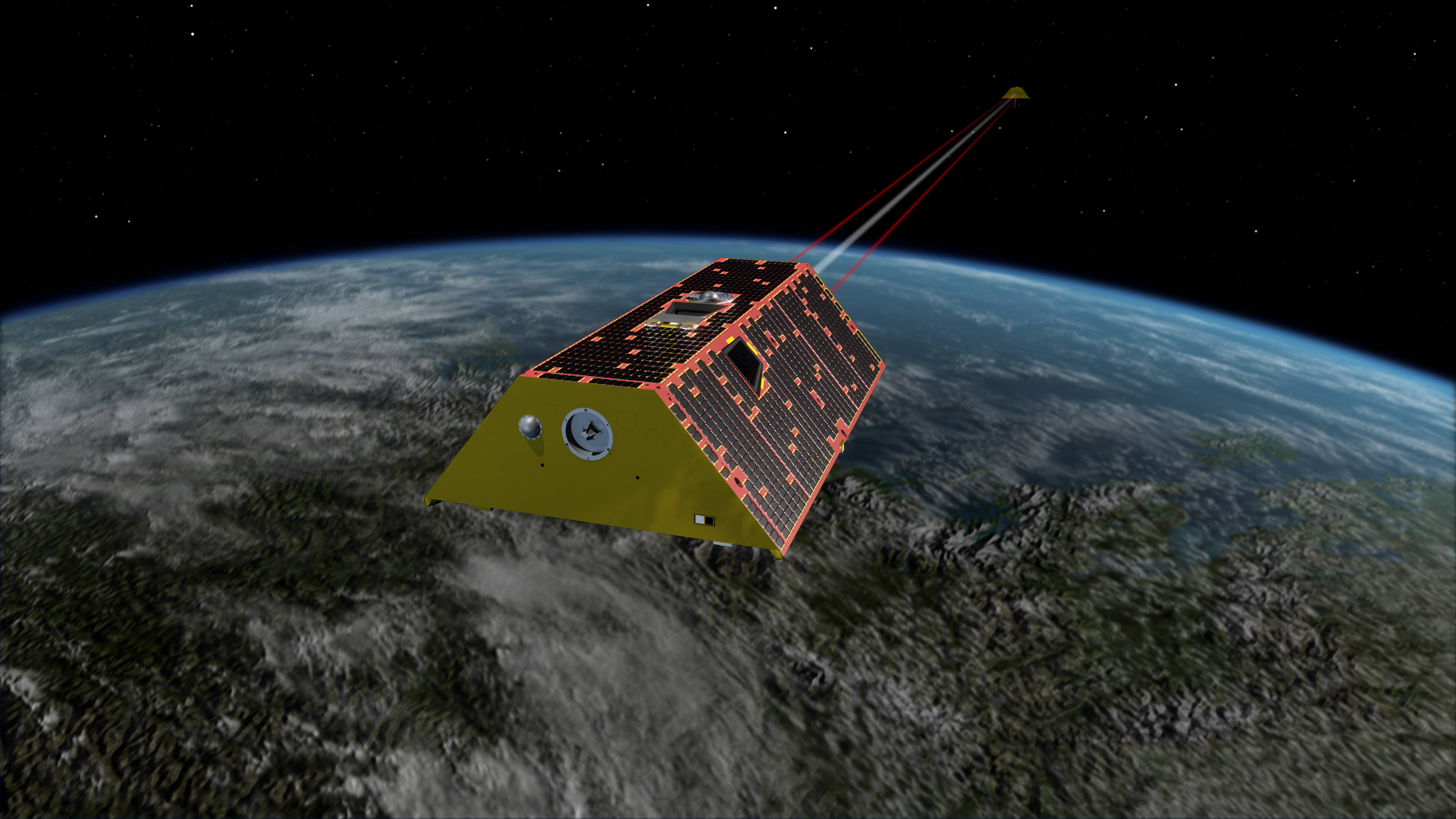
Mechanics is the physics of launching, flying and orbiting. The same equations put Earth-observing satellites such as Landsat 9 and GRACE-FO into orbit, keep them pointed, and turn tiny changes in their motion into maps of water, ice and land.
On the ground, the same ideas size wind turbines, make cars and aircraft use less energy, and help engineers plan how to move an asteroid. Each unit ends with a short, sourced section showing how its ideas help both people and nature.
Before you start
Prerequisites
- Algebra and trigonometry: solving equations, sine, cosine and tangent, the Pythagorean theorem.
- Calculus I, at least at the same time: derivatives as rates of change and integrals as areas. This course uses dv/dt and ∫v dt from Unit 1.
- Vectors in two dimensions: components, magnitude and direction.
- SI units and scientific notation.
How to study
- Read the unit, then close it and try the worked examples yourself before checking each step.
- Draw a picture for every problem. For any force problem, draw a free-body diagram before writing an equation.
- Solve with symbols first and put numbers in at the end. Then check the units and whether the size of the answer makes sense.
- Do every practice problem on paper before opening the answer. Getting it wrong first and fixing it is how the method sticks.
- Use the PhET simulations to test your intuition: predict what will happen, then run it.
- Retake the quizzes a few days later. Spaced practice beats one long session.
- Use g = 9.81 m/s² unless a problem says otherwise, and keep three significant figures.
Lab equipment (for the wet labs)
- Meter stick and tape measure; vernier caliper if available.
- Stopwatch (a phone works) and, ideally, a phone app or school sensor that records motion or acceleration.
- Low-friction cart and track (or a smooth board), a pulley and a set of hanging masses.
- A small ball, a ramp, carbon or plain paper for marking landing spots.
- String, a dense bob (a fishing weight works) and a protractor.
- Spreadsheet software for averages, standard deviations and graphs.
Suggested 15-week schedule
About 6 to 9 hours a week: reading, practice problems and, in lab weeks, the lab.
| Week | Unit | Topics | Reading |
|---|---|---|---|
| 1 | Measurement, Vectors & Motion in One Dimension | Units, uncertainty, vectors; Lab A | OpenStax 1.1–1.7, 2.1–2.2 |
| 2 | Measurement, Vectors & Motion in One Dimension | Velocity and acceleration as derivatives; constant acceleration; free fall | OpenStax 3.1–3.5 |
| 3 | Motion in Two Dimensions: Projectiles & Circles | Projectiles, relative motion, circular motion; Lab B | OpenStax 4.1–4.5 |
| 4 | Newton’s Laws, Friction & Circular Dynamics | Newton’s laws and free-body diagrams | OpenStax 5.1–5.7 |
| 5 | Newton’s Laws, Friction & Circular Dynamics | Friction, connected bodies, circular dynamics; Labs C and D | OpenStax 6.1–6.4 |
| 6 | Work, Energy & Power | Work, kinetic energy, power | OpenStax 7.1–7.4 |
| 7 | Work, Energy & Power | Potential energy and conservation of energy; Lab E | OpenStax 8.1–8.5 |
| 8 | Momentum, Collisions & Rockets | Momentum, impulse, collisions, center of mass, rockets; Lab F; midterm practice | OpenStax 9.1–9.7 |
| 9 | Rotation, Torque & Angular Momentum | Rotational kinematics, moment of inertia | OpenStax 10.1–10.5 |
| 10 | Rotation, Torque & Angular Momentum | Torque, rolling, angular momentum; Lab G | OpenStax 10.6–10.8, 11.1–11.3 |
| 11 | Gravitation & Orbits | Newton’s law of gravitation, g at altitude, satellites | OpenStax 13.1–13.4 |
| 12 | Gravitation & Orbits | Kepler’s laws, escape speed, orbital transfers | OpenStax 13.5–13.6 |
| 13 | Oscillations & Introduction to Fluids | Simple harmonic motion, pendulums, damping, resonance; Lab H | OpenStax 15.1–15.6 |
| 14 | Oscillations & Introduction to Fluids | Fluids: pressure, buoyancy, continuity, Bernoulli | OpenStax 14.1–14.6 |
| 15 | Review | Review and final practice set | All units |
Your progress
Tick units and labs as you finish them, and take the quizzes. Progress and quiz scores are saved only in this browser, never sent to us.
Turn on JavaScript to track progress.
Unit 1 · Weeks 1–2
Measurement, Vectors & Motion in One Dimension
How physicists measure, how vectors describe direction, and how position, velocity and acceleration are linked by calculus.
Learning objectives
By the end of this unit you can:
- Use SI units, significant figures and a stated uncertainty for every measured value.
- Add vectors by components and find a magnitude and direction.
- Define velocity as v = dx/dt and acceleration as a = dv/dt, and read them from graphs.
- Solve constant-acceleration problems, including free fall, with the four kinematic equations.
Key concepts
- Every measurement has an uncertainty. Report a value as best estimate ± uncertainty, with units, and round the uncertainty to one or two significant figures.
- A vector has a size and a direction. Add vectors by adding their x and y components, never their magnitudes.
- Velocity is the slope of a position–time graph; acceleration is the slope of a velocity–time graph. The area under a velocity–time graph is the displacement.
- With constant acceleration, the four kinematic equations follow from integrating a = constant twice.
- Near Earth’s surface, every object in free fall (no air resistance) accelerates downward at g ≈ 9.81 m/s², whatever its mass.
Key equations
Worked examples, step by step
Example 1.1 A car starts from rest and speeds up at a steady 3.0 m/s² for 8.0 s. How fast is it going, and how far has it traveled?
Show the steps
- Known: v₀ = 0, a = 3.0 m/s², t = 8.0 s.
- v = v₀ + at = 0 + 3.0 × 8.0 = 24 m/s.
- x = v₀t + ½at² = 0 + ½ × 3.0 × 8.0² = 96 m.
Answer: 24 m/s (86 km/h) after 96 m.
Example 1.2 A ball is thrown straight up at 15 m/s. How long does it take to reach the top, and how high does it go?
Show the steps
- At the top, v = 0. Take up as positive, so a = −9.81 m/s².
- Time: 0 = 15 − 9.81t, so t = 15 ÷ 9.81 = 1.53 s.
- Height: 0 = 15² − 2 × 9.81 × h, so h = 225 ÷ 19.62 = 11.5 m.
Answer: 1.53 s to the top, 11.5 m above the release point.
Example 1.3 A hiker walks 3.0 km east and then 4.0 km north. What is her displacement?
Show the steps
- Components: x = 3.0 km, y = 4.0 km.
- Magnitude: √(3.0² + 4.0²) = √25 = 5.0 km.
- Direction: tan⁻¹(4.0/3.0) = 53.1° north of east.
Answer: 5.0 km at 53.1° north of east. She walked 7.0 km, but her displacement is 5.0 km.
Practice problems
Work each on paper first, then check.
A car moving at 27 m/s brakes at a steady 6.0 m/s². How far does it travel before stopping, and how long does it take?
Show answer
Distance: 0 = 27² − 2 × 6.0 × d, so d = 729 ÷ 12 = 60.8 m. Time: t = 27 ÷ 6.0 = 4.5 s.
A stone is dropped from rest off a 20 m bridge. Ignoring air resistance, how long until it hits the water and how fast is it going?
Show answer
t = √(2h/g) = √(40 ÷ 9.81) = 2.02 s. v = gt = 9.81 × 2.02 = 19.8 m/s.
The position of a drone is x(t) = 2.0t³ − 3.0t (meters, seconds). Find its velocity and acceleration at t = 2.0 s.
Show answer
v = dx/dt = 6.0t² − 3.0 = 6.0 × 4 − 3.0 = 21 m/s. a = dv/dt = 12t = 24 m/s².
A low Earth orbit speed is about 7.8 km/s. Convert this to km/h.
Show answer
7.8 km/s × 3,600 s/h = 28,080 km/h, about 28,000 km/h.
A solar panel measures 2.50 ± 0.02 m by 1.20 ± 0.01 m. Find its area and the uncertainty.
Show answer
A = 2.50 × 1.20 = 3.00 m². Relative uncertainties: 0.02/2.50 = 0.8% and 0.01/1.20 = 0.83%. Combine in quadrature: √(0.8² + 0.83²) = 1.16%. ΔA = 0.0116 × 3.00 = 0.035 m². A = 3.00 ± 0.03 m².
Common misconceptions
Myth: If the velocity is zero, the acceleration must be zero too.
Actually: At the top of its flight a thrown ball has v = 0 but a = −9.81 m/s². Its velocity is still changing.
Myth: Heavier objects fall faster.
Actually: Without air resistance all objects fall with the same acceleration g. Air resistance, not weight, makes a feather fall slowly.
Myth: Distance and displacement are the same thing.
Actually: Displacement is a vector from start to finish. Walking around a running track once gives a distance of 400 m and a displacement of zero.
Flashcards
Displacement
Change in position, a vector: Δx = x_final − x_initial.
Velocity
Rate of change of position, v = dx/dt (m/s).
Acceleration
Rate of change of velocity, a = dv/dt (m/s²).
Free fall
Motion under gravity alone; a = g ≈ 9.81 m/s² downward.
Uncertainty
The range within which the true value probably lies, reported as ± with units.
Vector components
A_x = A cos θ, A_y = A sin θ.
Self-check quiz
How this helps save the planet
Earth-observing satellites are only useful if we know exactly where they were when each picture was taken. Their positions come from integrating velocity and acceleration over time, the same calculus as this unit, checked against GPS.
Landsat 9 orbits 705 km above Earth. Knowing its position to within meters lets scientists compare images taken years apart and measure forest loss, glacier retreat and crop health, which helps people manage land and protects habitats.
Uncertainty matters just as much: a measured change only counts if it is bigger than the uncertainty in the measurement.
On Saving Planets: Landsat 9 · Physics guide
Sources: NASA: Landsat 9 · JCGM: Guide to the expression of uncertainty
Free learning resources
- OpenStax University Physics 1, 3.1 Position, Displacement and Average Velocity: Free textbook section with worked examples.
- OpenStax University Physics 1, 3.4 Motion with Constant Acceleration: Derivations and practice problems.
- MIT OpenCourseWare 8.01SC Classical Mechanics: Free MIT lecture videos, notes and problem sets for the whole course.
- PhET: The Moving Man: Link position, velocity and acceleration graphs.
- PhET: Vector Addition: Add vectors by components.
Unit 2 · Week 3
Motion in Two Dimensions: Projectiles & Circles
Split motion into independent horizontal and vertical parts, then add circular motion, the key to every orbit.
Learning objectives
By the end of this unit you can:
- Treat horizontal and vertical motion of a projectile separately and find time of flight, range and maximum height.
- Find relative velocity by vector addition.
- Calculate centripetal acceleration and explain why it points to the center.
Key concepts
- Without air resistance, a projectile has constant horizontal velocity and constant downward acceleration g. The two directions are independent and share only time.
- On level ground the range is R = v₀² sin 2θ / g, largest at 45°.
- An object moving in a circle at constant speed is accelerating, because its direction changes. The acceleration a = v²/r points to the center.
- Velocities add as vectors: the velocity of a boat relative to the shore is its velocity relative to the water plus the water’s velocity.
Key equations
Worked examples, step by step
Example 2.1 A ball is launched at 20 m/s, 30° above level ground. Find the time of flight, range and maximum height.
Show the steps
- Components: vₓ = 20 cos 30° = 17.3 m/s; v_y = 20 sin 30° = 10.0 m/s.
- Time of flight: t = 2v_y/g = 20.0 ÷ 9.81 = 2.04 s.
- Range: R = vₓt = 17.3 × 2.04 = 35.3 m.
- Height: H = v_y²/2g = 100 ÷ 19.62 = 5.10 m.
Answer: 2.04 s, 35.3 m, 5.10 m.
Example 2.2 A package is thrown horizontally at 12 m/s from a 45 m cliff. Where does it land?
Show the steps
- Vertical: 45 = ½ × 9.81 × t², so t = √(90 ÷ 9.81) = 3.03 s.
- Horizontal: x = 12 × 3.03 = 36.3 m.
Answer: 36.3 m from the base of the cliff, after 3.03 s.
Example 2.3 A satellite circles Earth at 420 km altitude at 7.66 km/s. What is its centripetal acceleration? (Earth radius 6,371 km.)
Show the steps
- Orbit radius r = 6,371 + 420 = 6,791 km = 6.791 × 10⁶ m.
- a = v²/r = (7,660)² ÷ 6.791 × 10⁶ = 8.64 m/s².
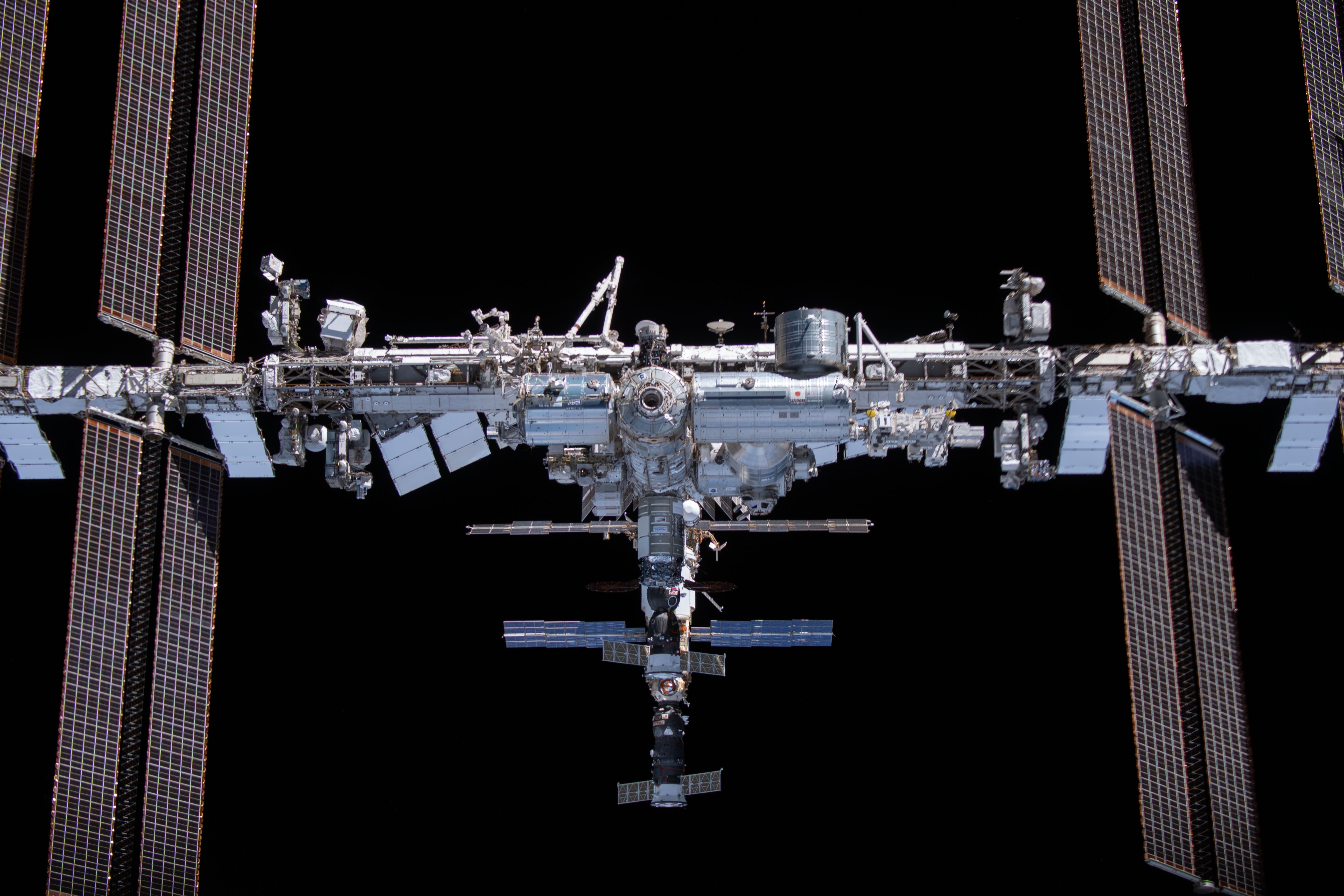
Answer: 8.64 m/s², about 88% of g at the surface. That acceleration is gravity itself: the satellite is in free fall around Earth.
Practice problems
Work each on paper first, then check.
At what angle does a projectile go farthest on level ground, and how far does it go if launched at 20 m/s?
Show answer
45°. R = v₀²/g = 400 ÷ 9.81 = 40.8 m.
A boat heads straight across a river at 4.0 m/s relative to the water. The current flows at 3.0 m/s. Find the boat’s speed relative to the shore and its direction.
Show answer
√(4.0² + 3.0²) = 5.0 m/s, at tan⁻¹(3.0/4.0) = 36.9° downstream of straight across.
A car rounds a 50 m radius curve at 15 m/s. What is its centripetal acceleration?
Show answer
a = 15² ÷ 50 = 4.5 m/s².
How fast does a point on the equator move because of Earth’s rotation? (Equatorial radius 6,378 km, one turn in 86,164 s.)
Show answer
v = 2πr/T = 2π × 6.378 × 10⁶ ÷ 86,164 = 465 m/s. Rockets launched eastward near the equator get this speed for free.
Common misconceptions
Myth: A bullet fired horizontally hits the ground later than one dropped from the same height.
Actually: Vertical motion does not depend on horizontal motion. Both hit at the same time (ignoring air resistance and Earth’s curvature).
Myth: Something moving in a circle at constant speed is not accelerating.
Actually: Its velocity changes direction, so it accelerates toward the center at v²/r.
Myth: At the top of a projectile’s path its velocity is zero.
Actually: Only the vertical part is zero. The horizontal part is unchanged.
Flashcards
Projectile
An object moving under gravity alone after launch.
Range
Horizontal distance on level ground: R = v₀² sin 2θ / g.
Centripetal acceleration
a = v²/r toward the center of a circle.
Angular speed ω
Rate of turning in rad/s; v = ωr.
Relative velocity
v_A rel ground = v_A rel B + v_B rel ground.
Period T
Time for one full circle: T = 2πr/v.
Self-check quiz
How this helps save the planet
An orbit is a projectile that never lands: fired fast enough sideways, it falls toward Earth at the same rate Earth’s surface curves away. That is why the satellite in Example 2.3 accelerates at v²/r while going nowhere closer.
Launch sites take advantage of Earth’s rotation. Firing eastward from near the equator adds up to about 465 m/s, which saves fuel on every launch of a weather or climate satellite.
Projectile thinking also protects people on the ground: the same equations, plus drag, are used to predict where a reentering stage or piece of debris could land.
On Saving Planets: Projectile motion with drag calculator · Orbits guide
Sources: OpenStax University Physics 1, 4.4 Circular Motion · ESA: Space debris
Free learning resources
- OpenStax University Physics 1, 4.3 Projectile Motion: Free textbook section with examples and problems.
- OpenStax University Physics 1, 4.4 Uniform and Nonuniform Circular Motion: Centripetal acceleration in depth.
- PhET: Projectile Motion: Change angle, speed and air resistance.
Unit 3 · Weeks 4–5
Newton’s Laws, Friction & Circular Dynamics
Forces cause acceleration. Free-body diagrams and ΣF = ma solve almost every problem in the course.
Learning objectives
By the end of this unit you can:
- State Newton’s three laws and identify action–reaction pairs.
- Draw a free-body diagram and apply ΣF = ma along chosen axes.
- Solve incline, pulley and connected-body problems with static and kinetic friction.
- Apply Newton’s second law to circular motion.
Key concepts
- First law: an object keeps its velocity unless a net force acts on it.
- Second law: ΣF = ma. Net force, not any single force, sets the acceleration.
- Third law: forces come in pairs, equal in size and opposite in direction, acting on different objects.
- Static friction can be anything up to μₛN; kinetic friction is μₖN and opposes sliding.
- In circular motion, the net inward force is m v²/r. It is supplied by real forces such as tension, friction, normal force or gravity.
Key equations
Worked examples, step by step
Example 3.1 A 1,500 kg car goes from 0 to 25 m/s in 10 s. What net force acts on it?
Show the steps
- a = Δv/Δt = 25 ÷ 10 = 2.5 m/s².
- ΣF = ma = 1,500 × 2.5 = 3,750 N.
Answer: 3,750 N forward.
Example 3.2 A 5.0 kg box slides down a 30° ramp with μₖ = 0.20. Find its acceleration.
Show the steps
- Axes along and perpendicular to the ramp.
- Perpendicular: N = mg cos 30°.
- Along: ma = mg sin 30° − μₖ mg cos 30°.
- a = 9.81 × (0.500 − 0.20 × 0.866) = 3.21 m/s². The mass cancels.
Answer: 3.21 m/s² down the ramp.
Example 3.3 An Atwood machine hangs 3.0 kg and 2.0 kg over a light, frictionless pulley. Find the acceleration and the tension.
Show the steps
- Heavier side moves down. For 3.0 kg: 3.0g − T = 3.0a. For 2.0 kg: T − 2.0g = 2.0a.
- Add: 1.0g = 5.0a, so a = 9.81 ÷ 5 = 1.96 m/s².
- T = 2.0 × (9.81 + 1.96) = 23.5 N.
Answer: a = 1.96 m/s², T = 23.5 N.
Practice problems
Work each on paper first, then check.
A 70 kg person stands on a scale in an elevator that accelerates upward at 1.5 m/s². What does the scale read?
Show answer
N − mg = ma, so N = 70 × (9.81 + 1.5) = 792 N (it reads as if they had a mass of 80.7 kg).
A 40 kg crate sits on a floor with μₛ = 0.50. What horizontal push just starts it moving?
Show answer
F = μₛ mg = 0.50 × 40 × 9.81 = 196 N.
A rocket of mass 5.0 × 10⁵ kg has 7.6 × 10⁶ N of thrust at liftoff. Find its initial acceleration.
Show answer
a = (T − mg)/m = 7.6 × 10⁶ ÷ 5.0 × 10⁵ − 9.81 = 15.2 − 9.81 = 5.39 m/s² upward. Its thrust-to-weight ratio is 1.55.
A 10 N push acts on a 2.0 kg block that pushes a 3.0 kg block on a frictionless floor. Find the acceleration and the force between the blocks.
Show answer
a = 10 ÷ 5.0 = 2.0 m/s². The force on the 3.0 kg block is 3.0 × 2.0 = 6.0 N.
What is the top speed for a car on a flat 40 m radius curve if μₛ = 0.60?
Show answer
Friction gives the inward force: μₛ mg = mv²/r, so v = √(μₛ g r) = √(0.60 × 9.81 × 40) = 15.3 m/s.
Common misconceptions
Myth: A moving object needs a force to keep it moving.
Actually: Only to overcome friction or drag. In space, a probe coasts for years with its engines off.
Myth: Action and reaction cancel, so nothing can accelerate.
Actually: They act on different objects, so they never cancel on one object.
Myth: The normal force always equals mg.
Actually: Only on a level surface with no vertical acceleration. On a ramp it is mg cos θ; in an accelerating elevator it changes.
Flashcards
Newton’s first law
Velocity stays constant unless a net force acts.
Newton’s second law
ΣF = ma.
Newton’s third law
Forces come in equal, opposite pairs on different objects.
Free-body diagram
Sketch of one object with every force acting on it.
Coefficient of friction μ
Ratio of friction force to normal force; no units.
Newton (N)
1 N = 1 kg·m/s².
Self-check quiz
How this helps save the planet
Newton’s third law is how every rocket works: it pushes exhaust backward and the exhaust pushes it forward. Those launches carry the satellites that monitor weather, wildfires, sea level and greenhouse gases.
Friction and drag are where much of our energy goes. Lower-friction tires and bearings, and more aerodynamic vehicles, need less force at the same speed and so less fuel or battery energy.
Thrust-to-weight is the first number engineers check on any launch vehicle: below 1, it cannot lift off.
On Saving Planets: Thrust-to-weight calculator · Earth observation
Sources: OpenStax University Physics 1, 5.3 Newton’s Second Law · U.S. DOE: Vehicle Technologies Office
Free learning resources
- OpenStax University Physics 1, 5.3 Newton’s Second Law: Free textbook section.
- OpenStax University Physics 1, 6.2 Friction: Static and kinetic friction with examples.
- OpenStax University Physics 1, 6.3 Centripetal Force: Banked curves and circular dynamics.
- PhET: Forces and Motion: Basics: Net force, friction and acceleration.
- PhET: The Ramp: Forces on an incline with friction.
Unit 4 · Weeks 6–7
Work, Energy & Power
Energy is the bookkeeping that makes hard force problems easy, and the language of every power plant, battery and engine.
Learning objectives
By the end of this unit you can:
- Compute work as W = ∫F·dx, including for a spring.
- Use the work–energy theorem and conservation of mechanical energy.
- Account for energy lost to friction, and compute power and efficiency.
- Estimate the power in wind with P = ½ρAv³.
Key concepts
- Work is force times displacement along the force: W = Fd cos θ for a constant force.
- The net work on an object equals its change in kinetic energy.
- Gravity and springs are conservative forces: their work can be stored as potential energy and given back.
- Friction turns mechanical energy into thermal energy; total energy is still conserved.
- Power is the rate of doing work, in watts (J/s).
Key equations
Worked examples, step by step
Example 4.1 A 1,200 kg car moving at 20 m/s brakes with a steady 6,000 N friction force. How far does it travel?
Show the steps
- K = ½ × 1,200 × 20² = 240,000 J.
- Friction work removes it all: 6,000 × d = 240,000.
- d = 40 m.
Answer: 40 m.
Example 4.2 A roller coaster starts from rest 30 m above the bottom of a dip. Ignoring friction, how fast is it at the bottom?
Show the steps
- mgh = ½mv², so the mass cancels.
- v = √(2gh) = √(2 × 9.81 × 30) = 24.3 m/s.
Answer: 24.3 m/s, whatever the path shape.
Example 4.3 A wind turbine has 50 m blades. How much power does a 10 m/s wind carry through its swept area, and what is the most any turbine could extract?
Show the steps
- A = πr² = π × 50² = 7,854 m².
- P = ½ρAv³ = ½ × 1.225 × 7,854 × 10³ = 4.81 × 10⁶ W.
- The Betz limit says no turbine can capture more than 16/27 (59.3%) of this: 0.593 × 4.81 MW = 2.85 MW.
Answer: The wind carries 4.81 MW; at most 2.85 MW could be captured. Real turbines get less.
Practice problems
Work each on paper first, then check.
A spring with k = 200 N/m is compressed 0.10 m and launches a 0.050 kg ball. How fast does the ball leave?
Show answer
Stored energy ½kx² = ½ × 200 × 0.01 = 1.0 J. v = √(2 × 1.0 ÷ 0.050) = 6.32 m/s.
A 50 N force pulls a sled 10 m at 30° above the horizontal. How much work does it do?
Show answer
W = Fd cos θ = 50 × 10 × 0.866 = 433 J.
How much power does it take to lift 70 kg up 3.0 m in 2.0 s?
Show answer
P = mgh/t = 70 × 9.81 × 3.0 ÷ 2.0 = 1,030 W.
A 1,500 kg car brakes from 25 m/s to a stop. How much kinetic energy is removed? If regenerative braking stored 60% of it, how much would that be?
Show answer
K = ½ × 1,500 × 25² = 468,750 J ≈ 469 kJ. 60% is 281 kJ.
If the wind speed falls from 10 m/s to 7 m/s, by what fraction does the wind power fall?
Show answer
Power goes as v³: (7/10)³ = 0.343, so it falls to about 34% of the original.
Common misconceptions
Myth: Carrying a heavy box across a level room at steady speed does a lot of work on it.
Actually: Gravity and your upward force are perpendicular to the motion, so they do no work on the box.
Myth: Energy is lost to friction.
Actually: It is converted to thermal energy, not destroyed. It is lost only as useful mechanical energy.
Myth: A turbine twice as big in diameter gets twice the power.
Actually: Power scales with area, so doubling the diameter gives four times the power.
Flashcards
Work
W = Fd cos θ; energy transferred by a force (J).
Kinetic energy
K = ½mv².
Potential energy
Stored energy of position: mgh, ½kx².
Work–energy theorem
W_net = ΔK.
Power
Rate of energy transfer, P = dW/dt (W).
Betz limit
No wind turbine can capture more than 16/27 ≈ 59.3% of the wind’s power.
Self-check quiz
How this helps save the planet
Wind turbines turn the kinetic energy of moving air into electricity. Because wind power grows with the cube of wind speed and with the square of blade length, engineers build taller towers and longer blades, which is why offshore turbines are so large.
Electric and hybrid vehicles use regenerative braking: the motor works as a generator and turns some of the car’s kinetic energy back into stored battery energy instead of heat.
Energy accounting is how engineers compare clean-energy options fairly, in joules and watts rather than claims.
On Saving Planets: Rotor hover power calculator · Calculators
Sources: U.S. DOE: How do wind turbines work? · U.S. DOE: Electric vehicle basics
Free learning resources
- OpenStax University Physics 1, 7.3 Work–Energy Theorem: Free textbook section.
- OpenStax University Physics 1, 8.3 Conservation of Energy: Energy diagrams and examples.
- PhET: Energy Skate Park: Watch kinetic, potential and thermal energy trade off.
Unit 5 · Week 8
Momentum, Collisions & Rockets
Momentum is conserved in every collision and explosion. It explains rockets, and how a spacecraft moved an asteroid.
Learning objectives
By the end of this unit you can:
- Relate impulse to change in momentum, J = ∫F dt = Δp.
- Apply conservation of momentum to elastic and inelastic collisions in one dimension.
- Find the center of mass of a system.
- Use the rocket equation Δv = vₑ ln(m₀/m_f).
Key concepts
- Momentum p = mv is a vector. With no external net force, total momentum of a system stays constant.
- In an elastic collision kinetic energy is also conserved; in an inelastic one some becomes heat, sound and deformation. In a perfectly inelastic collision the objects stick together.
- A longer collision time means a smaller average force for the same change in momentum. That is how airbags and crumple zones work.
- A rocket gains speed by throwing mass backward. Its speed change depends on exhaust speed and on the ratio of starting to final mass, not on how fast the fuel burns.
Key equations
Worked examples, step by step
Example 5.1 A 0.145 kg baseball arrives at 40 m/s and leaves the bat at 50 m/s in the opposite direction. Contact lasts 1.0 ms. Find the impulse and average force.
Show the steps
- Take the outgoing direction as positive: Δp = 0.145 × (50 − (−40)) = 0.145 × 90 = 13.1 kg·m/s.
- F = Δp/Δt = 13.05 ÷ 0.0010 = 13,000 N.
Answer: Impulse 13.1 kg·m/s; average force about 13,000 N.
Example 5.2 A 1,000 kg car at 20 m/s rear-ends a stopped 1,500 kg car and they lock together. Find their speed and the kinetic energy lost.
Show the steps
- Momentum: 1,000 × 20 = 2,500 × v, so v = 8.0 m/s.
- K before: ½ × 1,000 × 20² = 200 kJ. K after: ½ × 2,500 × 8.0² = 80 kJ.
- Lost: 120 kJ, 60% of the original.
Answer: 8.0 m/s; 120 kJ turned into deformation, heat and sound.
Example 5.3 A rocket stage has an exhaust speed of 3,000 m/s and a mass ratio m₀/m_f = 5. What speed change can it give, ignoring gravity and drag?
Show the steps
- Δv = vₑ ln(m₀/m_f) = 3,000 × ln 5.
- ln 5 = 1.609, so Δv = 4,830 m/s.
Answer: About 4.83 km/s. Reaching orbit at about 7.8 km/s needs more, which is why rockets use stages.
Practice problems
Work each on paper first, then check.
A 2.0 kg cart at 3.0 m/s hits a 1.0 kg cart at rest in a perfectly elastic collision. Find both final velocities.
Show answer
v₁ = (m₁ − m₂)/(m₁ + m₂) × 3.0 = 1.0 m/s; v₂ = 2m₁/(m₁ + m₂) × 3.0 = 4.0 m/s. Check: K before 9.0 J, after 1.0 + 8.0 = 9.0 J.
A 4.0 kg rifle fires a 0.010 kg bullet at 400 m/s. Find the rifle’s recoil speed.
Show answer
0 = 0.010 × 400 − 4.0v, so v = 1.0 m/s backward.
A 2.0 kg mass sits at x = 0 and a 3.0 kg mass at x = 5.0 m. Where is the center of mass?
Show answer
x_cm = (2.0 × 0 + 3.0 × 5.0) ÷ 5.0 = 3.0 m.
A stage with exhaust speed 3.5 km/s must provide Δv = 9.0 km/s on its own. What mass ratio is needed?
Show answer
m₀/m_f = e^(9.0/3.5) = e^2.571 = 13.1. Only about 7.6% of the starting mass could be anything other than propellant.
Common misconceptions
Myth: A rocket needs air to push against.
Actually: It pushes on its own exhaust. Rockets work best in a vacuum.
Myth: In an inelastic collision momentum is lost.
Actually: Momentum is conserved in every collision with no external force. Kinetic energy is what is lost.
Myth: A bigger force always means a bigger change in momentum.
Actually: Impulse is force × time. A small force over a long time can change momentum as much as a big force over a short time.
Flashcards
Momentum
p = mv (kg·m/s), a vector.
Impulse
J = ∫F dt = Δp.
Elastic collision
Momentum and kinetic energy both conserved.
Perfectly inelastic collision
Objects stick; maximum kinetic energy lost.
Center of mass
Mass-weighted average position of a system.
Rocket equation
Δv = vₑ ln(m₀/m_f).
Self-check quiz
How this helps save the planet
On Sept. 26, 2022, NASA’s DART spacecraft deliberately hit the asteroid moonlet Dimorphos. Its momentum shortened Dimorphos’s 11-hour-55-minute orbit around Didymos by about 33 minutes, far more than the 73-second minimum for success, because debris thrown off the asteroid added extra push.
It was the first test of moving an asteroid by kinetic impact, a way to protect people and every other living thing on Earth from a future impact. Neither asteroid was ever a threat to Earth.
The rocket equation drives cleaner launch design too: higher exhaust speed means less propellant for the same mission.
On Saving Planets: Planetary defense · Delta-v calculator
Sources: NASA: DART mission · NASA: Asteroid’s orbit and shape changed after DART impact
Free learning resources
- OpenStax University Physics 1, 9.3 Conservation of Linear Momentum: Free textbook section.
- OpenStax University Physics 1, 9.4 Types of Collisions: Elastic and inelastic collisions.
- OpenStax University Physics 1, 9.7 Rocket Propulsion: Derivation of the rocket equation.
- PhET: Collision Lab: Elastic and inelastic collisions in 1D and 2D.
Unit 6 · Weeks 9–10
Rotation, Torque & Angular Momentum
Everything that spins, from wheels and turbines to reaction wheels that point satellites, follows rotational versions of Newton’s laws.
Learning objectives
By the end of this unit you can:
- Use angular position, velocity and acceleration, and link them to linear motion with v = ωr.
- Compute moments of inertia and use τ = Iα.
- Solve rolling problems with energy conservation.
- Apply conservation of angular momentum.
Key concepts
- Rotational quantities mirror linear ones: θ ↔ x, ω ↔ v, α ↔ a, I ↔ m, τ ↔ F, L ↔ p.
- Moment of inertia depends on how mass is spread from the axis. Mass far from the axis is harder to spin up.
- Torque is a force times its lever arm: τ = rF sin θ.
- A rolling object has both translational and rotational kinetic energy, so it rolls down a slope slower than a frictionless block slides.
- With no external torque, angular momentum L = Iω stays constant.
Key equations
Worked examples, step by step
Example 6.1 A wind-turbine rotor speeds up from rest to 1.5 rad/s in 30 s at a steady rate. Find α and how many turns it makes.
Show the steps
- α = 1.5 ÷ 30 = 0.050 rad/s².
- θ = ½αt² = ½ × 0.050 × 30² = 22.5 rad.
- Turns: 22.5 ÷ 2π = 3.58.
Answer: α = 0.050 rad/s²; 3.58 turns.
Example 6.2 A solid ball rolls without slipping down a slope from 2.0 m high. How fast is it at the bottom?
Show the steps
- For a solid sphere, I = (2/5)mr², and ω = v/r.
- mgh = ½mv² + ½(2/5)mr²(v/r)² = (7/10)mv².
- v = √(10gh/7) = √(10 × 9.81 × 2.0 ÷ 7) = 5.29 m/s.
Answer: 5.29 m/s, less than the 6.26 m/s of a frictionless sliding block.
Example 6.3 A figure skater spinning at 2.0 rev/s pulls in her arms, cutting her moment of inertia from 4.0 to 1.6 kg·m². Find her new spin rate.
Show the steps
- L is conserved: I₁ω₁ = I₂ω₂.
- ω₂ = 4.0 × 2.0 ÷ 1.6 = 5.0 rev/s.
- Her kinetic energy rises by 2.5 times; the extra comes from the work her arms do.
Answer: 5.0 rev/s.
Practice problems
Work each on paper first, then check.
A 50 N force is applied at right angles to the end of a 0.30 m wrench. Find the torque.
Show answer
τ = 0.30 × 50 = 15 N·m.
A child of 30 kg sits 2.0 m from a seesaw pivot. Where must a 40 kg child sit to balance?
Show answer
30 × 2.0 = 40 × x, so x = 1.5 m on the other side.
A solid steel flywheel is a 100 kg disk of radius 0.50 m spinning at 300 rad/s. How much energy does it store?
Show answer
I = ½ × 100 × 0.50² = 12.5 kg·m². K = ½ × 12.5 × 300² = 562,500 J ≈ 0.563 MJ (0.156 kWh).
A satellite has I = 500 kg·m² about one axis. An onboard reaction wheel with I = 0.10 kg·m² spins up from rest to 600 rad/s. How fast does the satellite turn?
Show answer
Total L stays zero: 0.10 × 600 = 500 × ω, so ω = 0.12 rad/s the other way.
A torque of 2.0 N·m acts on a disk with I = 0.50 kg·m². Find α.
Show answer
α = τ/I = 4.0 rad/s².
Common misconceptions
Myth: Torque depends only on the size of the force.
Actually: It also depends on where and at what angle you push. Pushing a door near the hinge barely turns it.
Myth: All round objects roll down a slope at the same speed.
Actually: A solid ball beats a solid cylinder, which beats a hoop. Less of their energy goes into spinning.
Myth: Pulling in your arms creates angular momentum.
Actually: Angular momentum stays the same; the spin rate rises because I falls.
Flashcards
Angular velocity ω
Rate of rotation, rad/s.
Moment of inertia I
Resistance to angular acceleration; I = Σmr².
Torque τ
Turning effect of a force; τ = rF sin θ (N·m).
τ = Iα
Newton’s second law for rotation.
Angular momentum L
L = Iω; conserved with no external torque.
Rolling without slipping
v = ωr at the contact point; total K = ½mv² + ½Iω².
Self-check quiz
How this helps save the planet
Reaction wheels are one common way spacecraft point their instruments: spinning a wheel one way turns the spacecraft the other way, as in the practice problem, without using propellant.
Wind turbines are rotational machines. The torque of the wind on the blades turns the rotor, and the generator converts that rotation into electricity.
Flywheels store energy as rotation and can smooth out the grid; the physics is exactly K = ½Iω².
On Saving Planets: GRACE-FO · Earth observation
Sources: OpenStax University Physics 1, 11.3 Conservation of Angular Momentum · U.S. DOE: How do wind turbines work?
Free learning resources
- OpenStax University Physics 1, 10.4 Moment of Inertia and Rotational Kinetic Energy: Free textbook section.
- OpenStax University Physics 1, 10.6 Torque: Torque with examples.
- PhET: Balancing Act: Torque and balance on a seesaw.
Unit 7 · Weeks 11–12
Gravitation & Orbits
Newton’s law of gravity explains why satellites stay up, how long an orbit takes, and how to get from one orbit to another.
Learning objectives
By the end of this unit you can:
- Use Newton’s law of universal gravitation and find g at any altitude.
- Find the speed and period of a circular orbit and the radius of a geostationary orbit.
- Use gravitational potential energy to find escape speed.
- Apply Kepler’s three laws and estimate a Hohmann transfer.
Key concepts
- Every mass attracts every other mass with F = Gm₁m₂/r². Gravity weakens with the square of the distance from the center.
- A circular orbit happens when gravity supplies exactly the centripetal force: GMm/r² = mv²/r.
- Kepler’s laws: orbits are ellipses with the planet at one focus; a line to the planet sweeps equal areas in equal times; T² ∝ a³.
- Far from Earth, gravitational potential energy is U = −GMm/r. Escape speed is the speed that makes total energy zero.
- A Hohmann transfer moves between two circular orbits with two burns along a half-ellipse.
Key equations
Worked examples, step by step
Example 7.1 Find g at Earth’s surface from G, Earth’s mass and radius.
Show the steps
- g = GM/R² = 6.674 × 10⁻¹¹ × 5.972 × 10²⁴ ÷ (6.371 × 10⁶)².
- GM = 3.986 × 10¹⁴ m³/s²; R² = 4.059 × 10¹³ m².
- g = 9.82 m/s².
Answer: 9.82 m/s². Measured g varies from about 9.78 m/s² at the equator to 9.83 m/s² at the poles, because Earth spins and bulges at the equator; 9.81 m/s² is a convenient average.
Example 7.2 Landsat 9 orbits about 705 km above Earth. Treating the orbit as a circle, find its speed and period.
Show the steps
- r = 6,371 + 705 = 7,076 km = 7.076 × 10⁶ m.
- v = √(GM/r) = √(3.986 × 10¹⁴ ÷ 7.076 × 10⁶) = 7,505 m/s.
- T = 2πr/v = 2π × 7.076 × 10⁶ ÷ 7,505 = 5,924 s = 98.7 min.
Answer: 7.51 km/s and about 99 minutes per orbit, which matches the published figure.
Example 7.3 At what radius does a satellite orbit once per sidereal day (86,164 s), staying over one spot on the equator?
Show the steps
- r³ = GM T²/4π² = 3.986 × 10¹⁴ × 86,164² ÷ 39.48.
- r³ = 7.496 × 10²².
- r = 4.216 × 10⁷ m = 42,160 km from Earth’s center, about 35,790 km above the equator.
Answer: About 42,160 km from Earth’s center: geostationary orbit, where many weather satellites sit.
Practice problems
Work each on paper first, then check.
Find the escape speed from Earth’s surface.
Show answer
v = √(2GM/R) = √(2 × 3.986 × 10¹⁴ ÷ 6.371 × 10⁶) = 11.2 km/s.
At the ISS altitude of about 420 km, what fraction of surface gravity remains?
Show answer
(6,371 ÷ 6,791)² = 0.880. Astronauts float because they are in free fall, not because gravity is gone.
Mars orbits the Sun with a semi-major axis of 1.524 AU. How long is its year?
Show answer
Kepler: T = a^1.5 years = 1.524^1.5 = 1.88 Earth years.
Estimate the total Δv for a Hohmann transfer from a 300 km circular orbit to geostationary radius (42,164 km).
Show answer
r₁ = 6,671 km, r₂ = 42,164 km. Burn 1: √(GM/r₁)(√(2r₂/(r₁ + r₂)) − 1) = 2.43 km/s. Burn 2: √(GM/r₂)(1 − √(2r₁/(r₁ + r₂))) = 1.47 km/s. Total 3.90 km/s (plus any plane change).
Common misconceptions
Myth: There is no gravity in orbit.
Actually: At 420 km, gravity is still 88% of its surface value. Astronauts and the station fall together.
Myth: A heavier satellite needs to go faster to stay in the same orbit.
Actually: v = √(GM/r) has no satellite mass in it.
Myth: To catch up with a spacecraft ahead of you in the same orbit, speed up.
Actually: Speeding up raises your orbit and lengthens your period, so you fall behind. You slow down to drop into a faster, lower orbit.
Flashcards
Newton’s law of gravitation
F = Gm₁m₂/r².
Orbital speed
v = √(GM/r) for a circle.
Kepler’s third law
T² ∝ a³.
Escape speed
v = √(2GM/R); 11.2 km/s from Earth.
Geostationary orbit
Period one sidereal day, about 35,790 km above the equator.
Hohmann transfer
Two-burn half-ellipse between circular orbits.
Self-check quiz
How this helps save the planet
The twin GRACE-FO satellites fly about 220 km apart and measure the changing distance between them to about one micron. When the leading satellite passes over extra mass, such as a big aquifer or ice sheet, gravity tugs it ahead slightly. Mapping those tugs month by month shows where groundwater is being used up and how fast ice sheets are losing mass.
That gravity data helps people manage water during droughts and helps scientists track sea-level rise, which matters for coastal communities and wetlands alike.
Orbit choice is physics too: sun-synchronous orbits like Landsat 9’s repeat lighting conditions so changes on the ground can be compared fairly, and geostationary orbits let weather satellites watch storms continuously.
On Saving Planets: GRACE-FO · Orbital velocity calculator · Hohmann transfer calculator
Sources: NASA JPL: GRACE-FO · NASA: Landsat 9
Free learning resources
- OpenStax University Physics 1, 13.4 Satellite Orbits and Energy: Free textbook section.
- OpenStax University Physics 1, 13.5 Kepler’s Laws of Planetary Motion: Kepler’s laws derived and applied.
- PhET: Gravity and Orbits: Change masses and speeds and watch orbits form.
- PhET: Kepler’s Laws: Explore all three laws.
Unit 8 · Weeks 13–14
Oscillations & Introduction to Fluids
Springs and pendulums repeat in simple harmonic motion; fluids push with pressure and lift with buoyancy and flow.
Learning objectives
By the end of this unit you can:
- Describe simple harmonic motion and find period, frequency and maximum speed for a spring and a pendulum.
- Explain damping and resonance.
- Compute pressure at depth and buoyant force.
- Use the continuity equation and Bernoulli’s equation for steady flow.
Key concepts
- A restoring force proportional to displacement (F = −kx) gives simple harmonic motion, x = A cos(ωt + φ).
- The period of a mass on a spring does not depend on amplitude; a pendulum’s period depends only on its length and g for small swings.
- Pressure in a fluid increases with depth: P = P₀ + ρgh.
- Archimedes: the buoyant force equals the weight of fluid pushed aside.
- In steady flow, a fluid speeds up where a pipe narrows (continuity), and faster flow has lower pressure (Bernoulli).
Key equations
Worked examples, step by step
Example 8.1 A 0.50 kg mass on a spring with k = 200 N/m is pulled 5.0 cm and released. Find ω, the period, the frequency and the maximum speed.
Show the steps
- ω = √(k/m) = √(200 ÷ 0.50) = 20 rad/s.
- T = 2π/ω = 0.314 s; f = 1/T = 3.18 Hz.
- v_max = Aω = 0.050 × 20 = 1.0 m/s.
Answer: ω = 20 rad/s, T = 0.314 s, f = 3.18 Hz, v_max = 1.0 m/s.
Example 8.2 What is the period of a 1.00 m pendulum on Earth, and on the Moon (g = 1.62 m/s²)?
Show the steps
- Earth: T = 2π√(1.00 ÷ 9.81) = 2.01 s.
- Moon: T = 2π√(1.00 ÷ 1.62) = 4.94 s.
Answer: 2.01 s on Earth, 4.94 s on the Moon.
Example 8.3 Water flows at 2.0 m/s through a level pipe 4.0 cm across, which narrows to 2.0 cm. Find the new speed and the pressure drop.
Show the steps
- Area falls by (2.0/4.0)² = ¼, so v₂ = 4 × 2.0 = 8.0 m/s.
- Bernoulli, level pipe: ΔP = ½ρ(v₂² − v₁²) = ½ × 1,000 × (64 − 4.0) = 30,000 Pa.
Answer: 8.0 m/s and a pressure drop of 30 kPa.
Practice problems
Work each on paper first, then check.
What is the extra pressure 10 m below the surface of seawater (ρ = 1,025 kg/m³)?
Show answer
ρgh = 1,025 × 9.81 × 10 = 100,600 Pa, about one more atmosphere.
A block of wood with density 600 kg/m³ floats in fresh water. What fraction is under water?
Show answer
Floating: ρ_wood V g = ρ_water V_sub g, so V_sub/V = 600/1,000 = 0.60.
A pendulum must have a period of exactly 2.00 s. How long should it be?
Show answer
L = g(T/2π)² = 9.81 × (2.00 ÷ 6.283)² = 0.994 m.
Why can soldiers be told to break step when crossing a bridge?
Show answer
Marching in step pushes the bridge at a steady frequency. If that matches a natural frequency of the bridge, resonance can build up large oscillations.
Common misconceptions
Myth: A bigger swing makes a pendulum take longer.
Actually: For small swings the period does not depend on amplitude, only on L and g.
Myth: Heavy things sink and light things float.
Actually: Density decides. A steel ship floats because its shape pushes aside a weight of water equal to its own weight.
Myth: Faster-flowing fluid has higher pressure.
Actually: In steady, level flow, faster flow has lower pressure (Bernoulli).
Flashcards
Simple harmonic motion
Oscillation with restoring force ∝ displacement; x = A cos(ωt + φ).
Period
Time for one cycle; T = 1/f.
Resonance
Large response when driven at a natural frequency.
Pressure
Force per area, P = F/A (Pa).
Archimedes’ principle
Buoyant force = weight of displaced fluid.
Bernoulli’s equation
P + ½ρv² + ρgh is constant along a streamline in steady, ideal flow.
Self-check quiz
How this helps save the planet
Lift on a wing and on a wind-turbine blade comes from the air flowing faster over one side, which lowers the pressure there. Bernoulli’s equation is the first step in designing blades and wings that waste less energy.
Oscillation physics matters for clean-energy machines too: any tall structure that is pushed rhythmically, as a turbine tower is by its spinning rotor, can build up large vibrations if the push matches one of its natural frequencies (resonance).
Fluid pressure and buoyancy are behind ocean science too, from floats that measure the deep ocean to satellites such as Sentinel-6 that measure sea level to help coastal communities plan.
On Saving Planets: Pendulum period calculator · Lift equation calculator · Sentinel-6B
Sources: U.S. DOE: How do wind turbines work? · NASA: Sentinel-6 sea level mission
Free learning resources
- OpenStax University Physics 1, 15.1 Simple Harmonic Motion: Free textbook section.
- OpenStax University Physics 1, 15.4 Pendulums: Simple and physical pendulums.
- OpenStax University Physics 1, 14.4 Archimedes’ Principle and Buoyancy: Buoyancy with examples.
- OpenStax University Physics 1, 14.6 Bernoulli’s Equation: Flow, pressure and lift.
- PhET: Pendulum Lab: Period, length, mass and gravity.
- PhET: Masses and Springs: Springs, energy and damping.
- PhET: Buoyancy: Density and buoyant force.
- PhET: Under Pressure: Pressure at depth.
The lab (PHYS 110L)
The lab is the hands-on part of the course, a 1-credit component in a typical college schedule. Here it is free and for practice only.
Each lab tests one idea from lecture against real measurements, and each one asks you to state an uncertainty. A result without an uncertainty cannot be compared with a prediction. Every lab also has a home or PhET version.
Safety reference: OSHA: workplace safety
Lab A: Measurement and uncertainty (measuring g)
Week 1
Goal: Time a ball dropped from a measured height, find g, and state a proper uncertainty.
Procedure
- Measure the drop height h from the bottom of the ball to the floor; estimate δh (for a tape, about ±2 mm).
- Drop a dense ball from rest and time the fall. A phone slow-motion video or a sound-trigger app beats a hand stopwatch.
- Repeat at least five times.
- Find the mean time, the sample standard deviation s and the standard error s/√N; use the standard error as δt.
- Compute g and δg, and compare with 9.81 m/s².
Data table
| Trial | Fall time (s) |
|---|---|
| 1 | 0.55 |
| 2 | 0.56 |
| 3 | 0.54 |
| 4 | 0.55 |
| 5 | 0.56 |
| Mean | 0.552 |
| Std. deviation s | 0.0084 |
| Standard error s/√5 | 0.0037 |
Sample data for practice only. h = 1.500 ± 0.002 m.
Sample calculation
- g = 2h/t² = 2 × 1.500 ÷ 0.552² = 9.85 m/s².
- Relative uncertainty from time: 2 × 0.0037 ÷ 0.552 = 1.36%. From height: 0.002 ÷ 1.500 = 0.13%.
- Combined: √(1.36² + 0.13²) = 1.36%, so δg = 0.0136 × 9.85 = 0.13 m/s².
- Result: g = 9.85 ± 0.13 m/s². The accepted 9.81 m/s² lies inside the range, so the two agree. Timing dominates the uncertainty.
Safety
- Drop the ball only where nobody is underneath, and keep the floor clear.
- Stand on a sturdy surface, not a chair, to reach the release height.
Home or virtual alternative
- Do it exactly as written at home with a phone slow-motion video.
- Or use the PhET Projectile Motion sim with launch speed 0 to check timing.
PhET: Projectile Motion · JCGM uncertainty guide (GUM)
Planet link: GRACE-FO’s science only works because its team knows the uncertainty of every distance it measures; a change counts only when it beats that uncertainty. NASA JPL: GRACE-FO
Lab B: Projectile motion
Week 3
Goal: Measure a launcher’s speed from a horizontal shot, then predict and test where an angled shot lands.
Procedure
- Fire a ball horizontally from a launcher (or roll it off a ramp) at table height h.
- Tape carbon paper over plain paper where it lands; do five shots and measure each landing distance x.
- Find the mean x and compute v₀.
- Predict the range for a 30° launch from floor level, mark the spot, and test it with five shots.
- Compare prediction and result; list sources of error (air drag, launch height, angle reading).
Data table
| Quantity | Value |
|---|---|
| Table height h | 1.00 m |
| Mean landing distance x | 2.26 m |
| Fall time √(2h/g) | 0.452 s |
| Launch speed v₀ | 5.01 m/s |
| Predicted range at 30° | 2.21 m |
Sample data for practice only.
Sample calculation
- t = √(2 × 1.00 ÷ 9.81) = 0.452 s.
- v₀ = 2.26 ÷ 0.452 = 5.01 m/s.
- R(30°) = 5.01² × sin 60° ÷ 9.81 = 25.1 × 0.866 ÷ 9.81 = 2.21 m.
- Percent difference = |measured − predicted| ÷ predicted × 100%.
Safety
- Wear eye protection with any spring launcher, and never aim it at a person.
- Keep the landing zone clear.
Home or virtual alternative
- Roll a marble off a table and measure x; skip the angled part or use the PhET sim for it.
Planet link: The same prediction-then-test method is used to forecast where a reentering rocket stage could land.
Lab C: Newton’s second law
Week 5
Goal: Show that acceleration is proportional to net force and inversely proportional to mass.
Procedure
- Level a track. Attach a cart (mass m_c) by string over a pulley to a hanging mass m_h.
- Release from rest and record the motion with a sensor, video or by timing a known distance (a = 2d/t²).
- Repeat for five hanging masses, moving mass from the cart to the hanger so the total stays fixed.
- Graph a against m_h g. The slope should be 1/(m_c + m_h).
- Repeat with extra mass on the cart to test the mass dependence.
Data table
| Quantity | Value |
|---|---|
| Cart mass m_c | 0.500 kg |
| Hanging mass m_h | 0.050 kg |
| Predicted a | 0.892 m/s² |
| Measured a | 0.86 m/s² |
Sample data for practice only.
Sample calculation
- Predicted a = 0.050 × 9.81 ÷ 0.550 = 0.892 m/s².
- Measured 0.86 m/s² is 3.6% lower.
- Friction force needed to explain the gap: (0.892 − 0.86) × 0.550 = 0.018 N, a reasonable rolling friction.
Safety
- Put a soft stop at the end of the track and keep fingers clear of the pulley.
Home or virtual alternative
- Use PhET Forces and Motion: Basics (Acceleration screen) to vary force and mass.
PhET: Forces and Motion: Basics
Planet link: F = ma is why lighter vehicles need less energy to speed up: every kilogram saved cuts the force, and the fuel, needed.
Lab D: Friction
Week 5
Goal: Measure static and kinetic friction coefficients with a tilting ramp.
Procedure
- Place a block on a board and slowly raise one end until the block just starts to slide; record the angle θ_slip. Repeat five times.
- Find the angle at which the block, given a tap, slides down at a steady speed: θ_steady.
- Compute μₛ and μₖ. Repeat on a second surface (felt, rubber).
Data table
| Quantity | Value |
|---|---|
| Block mass | 0.250 kg |
| Mean slip angle | 31° |
| Mean steady-slide angle | 24° |
| μₛ | 0.60 |
| μₖ | 0.45 |
Sample data for practice only.
Sample calculation
- μₛ = tan 31° = 0.601.
- μₖ = tan 24° = 0.445.
- As expected, μₖ < μₛ. The mass does not appear: it cancels.
Safety
- Keep the ramp low and stable; catch the block at the bottom.
Home or virtual alternative
- A book, a phone inclinometer app and a hardcover board work fine.
- PhET The Ramp lets you set friction and watch the forces.
Planet link: Rolling friction in tires is one of the forces a vehicle burns energy against at every speed; lower-friction designs save fuel. U.S. DOE: Vehicle Technologies Office
Lab E: Conservation of energy
Week 7
Goal: Compare a cart’s measured speed at the bottom of a ramp with the speed energy conservation predicts.
Procedure
- Measure the vertical drop h of a ramp.
- Release a low-friction cart from rest and measure its speed at the bottom (photogate, or video over a short known distance).
- Repeat five times and average.
- Compute the predicted speed and the fraction of energy kept; explain where the rest went.
Data table
| Quantity | Value |
|---|---|
| Drop height h | 0.300 m |
| Predicted speed | 2.43 m/s |
| Measured speed (mean) | 2.35 m/s |
| Energy kept | 93.8% |
Sample data for practice only.
Sample calculation
- v = √(2 × 9.81 × 0.300) = 2.43 m/s.
- Fraction kept = 2.35² ÷ (2 × 9.81 × 0.300) = 5.52 ÷ 5.89 = 0.938.
- About 6.2% of the mechanical energy became heat and sound through friction and drag.
Safety
- Clamp the ramp and stop the cart at the bottom.
Home or virtual alternative
- Roll a ball down a book-ramp and time it over a measured flat run.
- PhET Energy Skate Park shows the same energy bar charts.
Planet link: Tracking where energy goes is how engineers find savings, from regenerative braking to pumped-storage hydro. U.S. DOE: Electric vehicle basics
Lab F: Momentum and collisions
Week 8
Goal: Test conservation of momentum in elastic and sticky collisions, and measure how much kinetic energy is lost.
Procedure
- On a level track, send cart 1 into cart 2 at rest with Velcro facing so they stick.
- Measure speeds just before and after (sensor or video).
- Repeat with magnets or springs facing for a nearly elastic bounce.
- For each run, compare total momentum and total kinetic energy before and after.
Data table
| Quantity | Value |
|---|---|
| m₁ = m₂ | 0.50 kg |
| v₁ before | 0.80 m/s |
| Predicted v after (stuck) | 0.40 m/s |
| Measured v after | 0.39 m/s |
Sample data for practice only.
Sample calculation
- p before = 0.50 × 0.80 = 0.40 kg·m/s. p after = 1.00 × 0.39 = 0.39 kg·m/s, a 2.5% difference (friction during the run).
- K before = ½ × 0.50 × 0.80² = 0.160 J. K after = ½ × 1.00 × 0.39² = 0.076 J.
- About half the kinetic energy was lost, as theory predicts for equal masses sticking (exactly 50% ideally).
Safety
- Keep speeds low and stop carts before the track ends.
Home or virtual alternative
- PhET Collision Lab lets you set elasticity from 0% to 100%.
Planet link: DART used exactly this physics on an asteroid: a planned, measured collision to change a moonlet’s orbit. NASA: DART mission
Lab G: Rotational inertia
Week 10
Goal: Measure a disk’s moment of inertia with a falling mass and compare it with ½MR².
Procedure
- Wind a string around the disk’s axle (radius r) and hang a mass m from it.
- Release from rest and time the fall through a height d; repeat five times.
- Compute a, then I. Measure the disk’s mass M and radius R and compute ½MR².
- Compare. Then add a ring and see how much I grows.
Data table
| Quantity | Value |
|---|---|
| Hanging mass m | 0.050 kg |
| Axle radius r | 0.025 m |
| Fall distance d | 0.800 m |
| Mean fall time t | 4.00 s |
| Disk M, R | 1.50 kg, 0.064 m |
Sample data for practice only.
Sample calculation
- a = 2 × 0.800 ÷ 4.00² = 0.100 m/s².
- I = 0.050 × 0.025² × (9.81 ÷ 0.100 − 1) = 0.050 × 0.000625 × 97.1 = 3.03 × 10⁻³ kg·m².
- ½MR² = ½ × 1.50 × 0.064² = 3.07 × 10⁻³ kg·m².
- Difference 1.2%, within the uncertainty of the radius and timing.
Safety
- Keep the hanging mass low over a soft landing pad.
Home or virtual alternative
- Roll a full can of soup and an empty can down the same ramp and compare times; explain the result with K = ½mv² + ½Iω².
OpenStax 10.4 Moment of Inertia
Planet link: Reaction wheels that point Earth-observing satellites are designed around exactly this quantity.
Lab H: Pendulum and simple harmonic motion
Week 13
Goal: Test T = 2π√(L/g), show the period does not depend on mass or small amplitude, and measure g a second way.
Procedure
- Hang a dense bob on a string; measure L from the pivot to the bob’s center.
- Pull it back less than 10° and time 20 full swings; divide by 20 for T.
- Repeat for five lengths. Graph T² against L: the slope is 4π²/g.
- Change the bob mass and the amplitude (still small) and check that T stays the same.
- Optional: time a mass bouncing on a spring and test T = 2π√(m/k).
Data table
| Quantity | Value |
|---|---|
| Length L | 0.800 m |
| Time for 20 swings | 35.9 s |
| Period T | 1.795 s |
| g | 9.80 m/s² |
Sample data for practice only.
Sample calculation
- T = 35.9 ÷ 20 = 1.795 s. Timing 20 swings divides the reaction-time error by 20.
- g = 4π² × 0.800 ÷ 1.795² = 31.58 ÷ 3.222 = 9.80 m/s².
- Compare with Lab A: two independent methods, and the pendulum is far more precise.
Safety
- Use a secure pivot and swing the bob away from faces.
Home or virtual alternative
- A key on a shoelace works; time it with a phone.
PhET: Pendulum Lab · PhET: Masses and Springs
Planet link: Precise knowledge of g, and of its tiny changes from place to place, is what gravity missions such as GRACE-FO turn into maps of water and ice. NASA JPL: GRACE-FO
Exam prep practice sets
Time yourself: about 10 minutes per problem. Then compare with the full solutions.
Midterm practice set (Units 1–4)
A rocket accelerates straight up from rest at 5.0 m/s² for 20 s, then its engine stops. What is the maximum height it reaches?
Show full solution
- At burnout: v = 5.0 × 20 = 100 m/s; height = ½ × 5.0 × 20² = 1,000 m.
- Coasting up: extra height = v²/2g = 100² ÷ 19.62 = 510 m.
Answer: 1,510 m, ignoring drag.
A ball is kicked at 25 m/s at 40° above level ground. Find its range and time of flight.
Show full solution
- v_y = 25 sin 40° = 16.1 m/s; t = 2 × 16.1 ÷ 9.81 = 3.28 s.
- R = 25² × sin 80° ÷ 9.81 = 625 × 0.985 ÷ 9.81 = 62.7 m.
Answer: 62.7 m in 3.28 s.
A 20 kg sled is pulled at constant speed across snow (μₖ = 0.10) by a horizontal rope. Find the rope tension and the work done over 50 m.
Show full solution
- Constant speed: T = μₖmg = 0.10 × 20 × 9.81 = 19.6 N.
- W = 19.6 × 50 = 981 J.
Answer: 19.6 N; 981 J, all turned into heat by friction.
A 2.0 kg block slides from rest down a frictionless curved track from 5.0 m high and then compresses a spring (k = 400 N/m) on level ground. Find the maximum compression.
Show full solution
- mgh = ½kx².
- x = √(2 × 2.0 × 9.81 × 5.0 ÷ 400) = √0.4905 = 0.700 m.
Answer: 0.700 m.
Final practice set (all units)
A 3.0 kg cart at 4.0 m/s collides with a 1.0 kg cart at rest and they stick. Find the final speed and the fraction of kinetic energy lost.
Show full solution
- v = 3.0 × 4.0 ÷ 4.0 = 3.0 m/s.
- K before = 24 J; after = ½ × 4.0 × 9.0 = 18 J.
Answer: 3.0 m/s; 25% of the kinetic energy is lost.
A hollow ring and a solid disk of equal mass and radius roll from rest down a ramp 1.0 m high. Find each speed at the bottom.
Show full solution
- Ring (I = mr²): mgh = mv², so v = √(gh) = 3.13 m/s.
- Disk (I = ½mr²): mgh = ¾mv², so v = √(4gh/3) = 3.62 m/s.
Answer: Ring 3.13 m/s, disk 3.62 m/s; the disk wins.
Find the orbital period of a satellite in a circular orbit 1,336 km above Earth.
Show full solution
- r = 6,371 + 1,336 = 7,707 km.
- T = 2π√(r³/GM) = 2π√((7.707 × 10⁶)³ ÷ 3.986 × 10¹⁴) = 6,733 s.
Answer: About 112 minutes.
A 0.20 kg mass on a spring oscillates with a period of 0.50 s and amplitude 0.10 m. Find k and the maximum speed.
Show full solution
- ω = 2π ÷ 0.50 = 12.57 rad/s.
- k = mω² = 0.20 × 158.0 = 31.6 N/m.
- v_max = Aω = 0.10 × 12.57 = 1.26 m/s.
Answer: k = 31.6 N/m; v_max = 1.26 m/s.
A 1.0 m³ buoy of mass 400 kg is held fully under seawater (ρ = 1,025 kg/m³) by a cable to the seabed. Find the cable tension.
Show full solution
- Buoyant force = 1,025 × 1.0 × 9.81 = 10,060 N.
- Weight = 400 × 9.81 = 3,920 N.
- Tension = 10,060 − 3,920 = 6,130 N.
Answer: About 6,130 N.
Formula sheet
Constants
| Constant | Value |
|---|---|
| Gravitational constant, G | 6.674 × 10⁻¹¹ N·m²/kg² |
| Standard gravity, g | 9.81 m/s² (9.80665 m/s² by definition) |
| Mass of Earth | 5.972 × 10²⁴ kg (NASA Earth fact sheet) |
| Mean radius of Earth | 6,371 km (NASA Earth fact sheet) |
| GM of Earth | 3.986 × 10¹⁴ m³/s² |
| Sidereal day | 86,164 s |
| Density of fresh water | 1,000 kg/m³; seawater about 1,025 kg/m³ |
| Density of air at sea level, 15 °C | 1.225 kg/m³ |
Reference data
Use these free, official data sources alongside the course.
- NASA Earth fact sheet: Mass, radius, gravity and orbit data for Earth (and links to other planets).
- NIST SI units: The seven SI base units and how they are defined.
- JCGM publications (GUM): The international guide to expressing measurement uncertainty.
Glossary
- Acceleration
- Rate of change of velocity, dv/dt.
- Amplitude
- Maximum displacement from equilibrium in an oscillation.
- Angular momentum
- L = Iω; conserved without external torque.
- Buoyant force
- Upward force from a fluid, equal to the weight of fluid displaced.
- Center of mass
- Mass-weighted average position of a system.
- Conservative force
- A force whose work does not depend on path, such as gravity or a spring.
- Displacement
- Change in position, a vector.
- Elastic collision
- A collision that conserves kinetic energy.
- Escape speed
- Minimum speed to leave a body’s gravity without further thrust.
- Free-body diagram
- Diagram of all forces on one object.
- Frequency
- Cycles per second (Hz); f = 1/T.
- Geostationary orbit
- An equatorial orbit with a one-sidereal-day period.
- Impulse
- Force integrated over time; equals change in momentum.
- Inertia
- Resistance to change in motion; measured by mass.
- Kinetic energy
- Energy of motion, ½mv².
- Moment of inertia
- Rotational inertia, Σmr².
- Momentum
- p = mv.
- Newton
- SI unit of force, kg·m/s².
- Period
- Time for one cycle or one orbit.
- Power
- Rate of energy transfer, in watts.
- Pressure
- Force per unit area, in pascals.
- Resonance
- Large oscillation when driven at a natural frequency.
- Standard error
- Standard deviation of the mean, s/√N.
- Sun-synchronous orbit
- A near-polar orbit that passes over each place at about the same local solar time.
- Torque
- Turning effect of a force, rF sin θ.
- Uncertainty
- Estimated range around a measured value that probably contains the true value.
- Vector
- A quantity with size and direction.
- Weight
- Gravitational force on a mass, mg.
- Work
- Energy transferred by a force over a displacement.
Self-assessment rubric
No grade or credit is given. Use this to judge honestly where you are in each unit.
| Level | What it looks like |
|---|---|
| 4 · Mastery | Solves new, unseen problems correctly, starts from a diagram and a principle (Newton, energy or momentum), and checks units and limits. |
| 3 · Proficient | Solves the practice problems with correct units and sensible significant figures; occasional slips. |
| 2 · Developing | Follows worked examples but struggles to choose a method for new problems, or mixes up vectors and scalars. |
| 1 · Beginning | Plugs numbers into formulas without a diagram; needs to revisit the unit. |
Suggested weighting if you want a score
| Part | Weight |
|---|---|
| Practice problems | 30% |
| Lab write-ups (or virtual labs) | 20% |
| Midterm practice set | 20% |
| Final practice set | 30% |
Aim for level 3 or better in every unit before moving to the next course.