Want to go deeper? NASA, First greenhouse gas plumes detected has the full story and the latest updates.
 For Further Information
Tanager-1 was built by Planet with a NASA JPL-designed imaging spectrometer for the nonprofit Carbon Mapper coalition.
Image: NASA/JPL-Caltech (Carbon Mapper data).
Last reviewed: 2 sources cited
Planet built it with a NASA JPL-designed imaging spectrometer for the nonprofit Carbon Mapper coalition.
A satellite that pinpoints methane and carbon dioxide plumes from individual sources.
First published methane detection September 19, 2024.
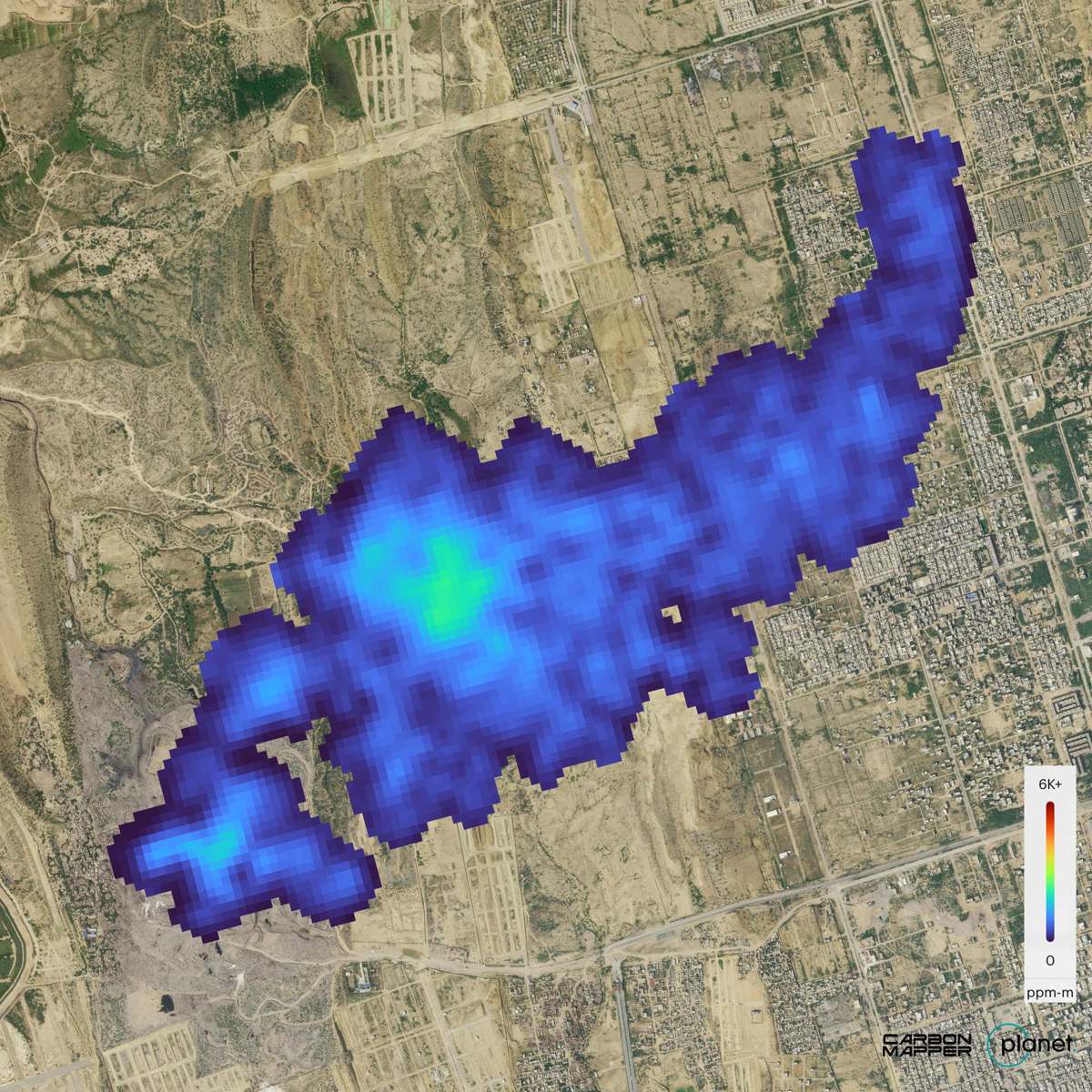
Earth The curved path an object takes as it travels around a planet, moon or star, like a satellite circling Earth. Glossary; its first published plume was a landfill in Karachi, Pakistan.
Finding single leaks lets operators and regulators fix them fast.
Corporate / nonprofit solution · active
Tanager-1 was built by Planet with a NASA JPL-designed imaging spectrometer for the nonprofit Carbon Mapper coalition. Its first published methane detection, on September 19, 2024, was a landfill plume in Karachi, Pakistan, with a preliminary estimated rate of 1,200 kg of methane per hour (Carbon Mapper estimate, reported by NASA).
Source: NASA, First greenhouse gas plumes detected
Source: Carbon Mapper, first Tanager-1 detections (company release)
Pinpointing single leaks lets operators and regulators fix them fast, one of the quickest ways to cut warming.
For Further Information: NASA, First greenhouse gas plumes detected
Want to go deeper? NASA, First greenhouse gas plumes detected has the full story and the latest updates.
For Further InformationMore solutions like this one, matched by meaning.
Links go straight to the organization. Saving Planets doesn't receive any of the money.
Sources are listed with each fact in the Five W's above.
APA
Saving Planets. (n.d.). Tanager-1 (Carbon Mapper / Planet). https://www.savingplanets.com/Tanager-1.html
MLA
"Tanager-1 (Carbon Mapper / Planet)." Saving Planets, https://www.savingplanets.com/Tanager-1.html.