Want to go deeper? NASA's NEO Surveyor page has the mission's latest build updates.
 For further information
Finding asteroids before they find us.
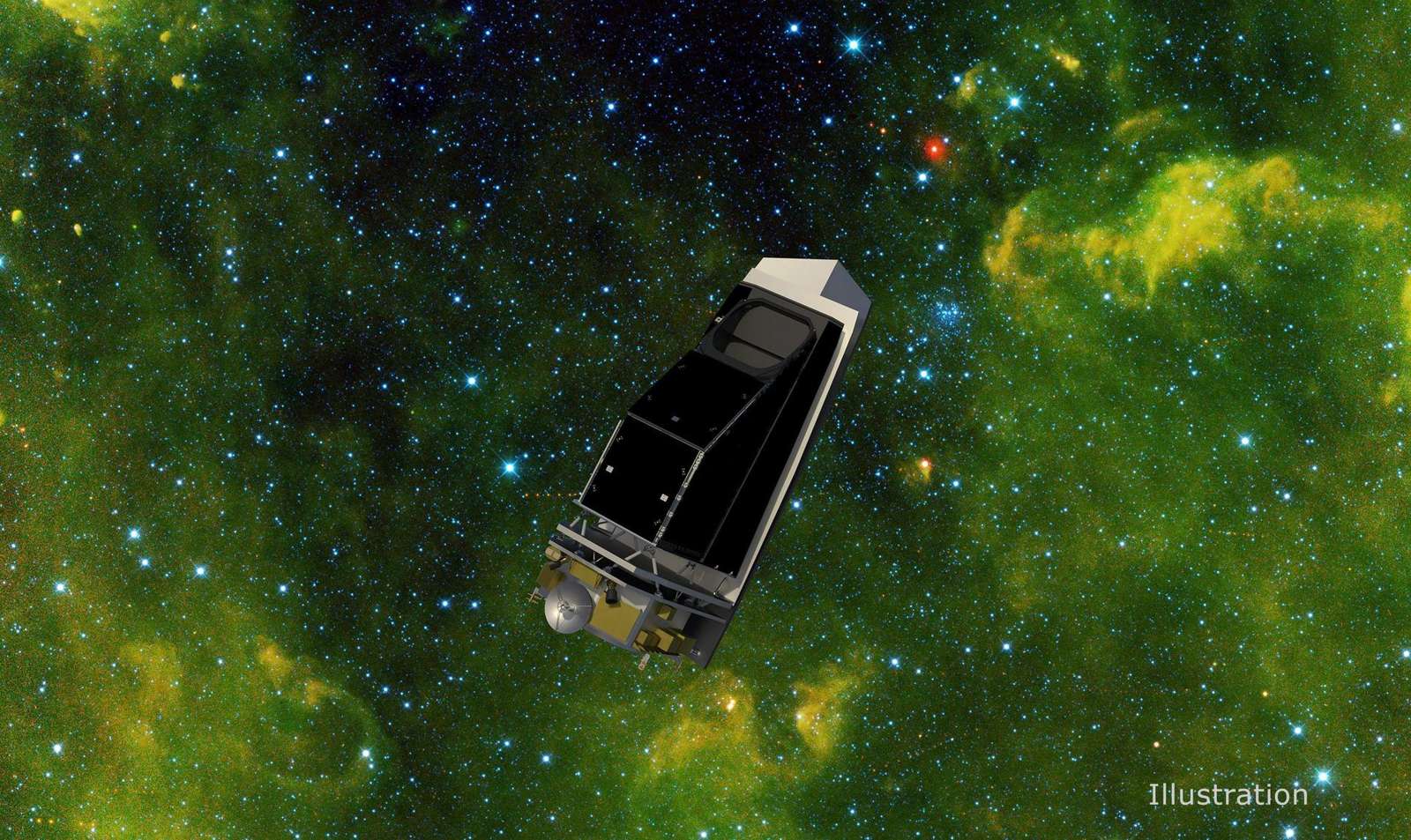
Image: NASA/JPL-Caltech/University of Arizona (PIA25253, illustration).
NASA, with the mission built at NASA's Jet Propulsion Laboratory and overseen by the Planetary Defense Coordination Office. BAE Systems, Space Dynamics Laboratory and Teledyne build parts of the spacecraft and instrument.
Source: NASA, launch services contract
The first space telescope specifically designed to detect asteroids and comets that may be potential hazards to Earth: a single telescope about 50 cm (almost 20 inches) across, seeing in two heat-sensing infrared wavelengths.
Source: NASA, NEO Surveyor
Source: NASA, launch services contract
Launch no earlier than September 2027, on a SpaceX Falcon 9 from Florida.
Source: NASA, launch services contract
Deep space, looking for objects that come within 30 million miles of Earth's orbit, including those approaching from the direction of the Sun, where daytime glare hides them from ground telescopes.
Source: NASA, NEO Surveyor
Source: NASA, launch services contract
We can only do something about a hazardous asteroid if we find it first. Dark asteroids reflect little visible light but glow in the infrared as sunlight heats them, so an infrared telescope finds what others miss.
Source: NASA, NEO Surveyor
Over a five-year baseline survey, NEO Surveyor is designed to find at least two-thirds of the unknown near-Earth objects larger than 140 meters (460 feet), the size that could cause major regional damage if one hit Earth. Two infrared channels also measure each object's size more accurately and reveal clues to its composition, shape, spin and orbit.
Source: NASA, launch services contract
Finding them is the first half of planetary defense. Missions like DART and Hera are the second half.
Want to go deeper? NASA's NEO Surveyor page has the mission's latest build updates.
For further information