Want to go deeper? ESA's Hera pages have the mission timeline, videos and the latest images.
 For further information
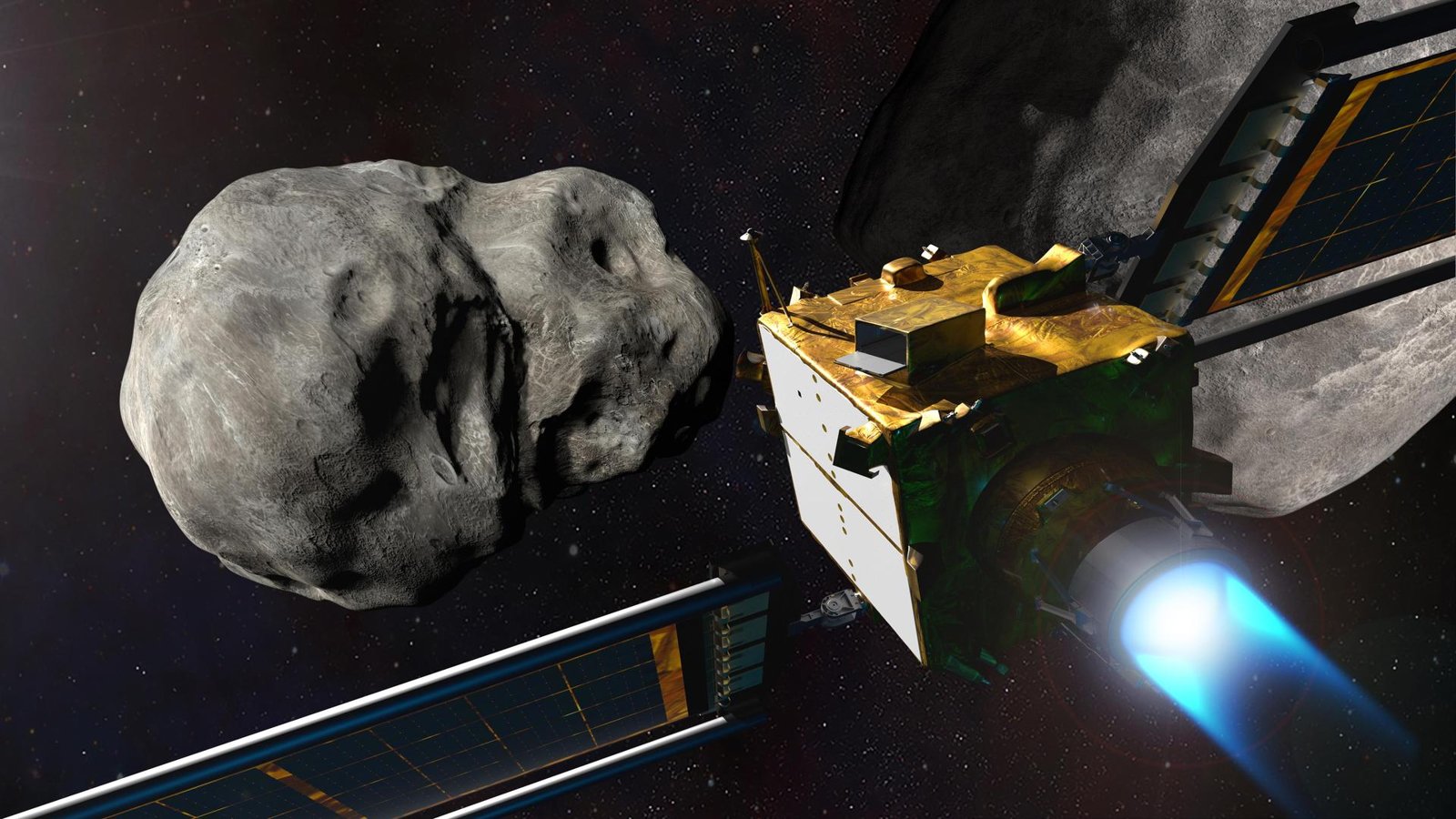
Crash scene investigators for the first asteroid humans ever moved.
Image: ESA – Science Office, CC BY-SA 3.0 IGO. Resized from the original.
The European Space Agency, through its Space Safety programme, working with NASA under the international AIDA collaboration. Hera carries two CubeSats: Milani and Juventas.
Source: ESA, Hera mission overview
A small, van-sized deep-space spacecraft that will perform a close-up "crash scene investigation" of Dimorphos, measuring its mass, its shifted orbit and DART's impact crater. Juventas will make the first radar sounding inside an asteroid.
Source: ESA, Hera mission overview
Launched October 7, 2024. Thanks to good engine performance, it is on track to arrive in November 2026, a month earlier than planned. A deep-space burn in early 2026 used 123 kg of fuel and changed its speed by 367 m/s.
Source: ESA, Hera targets early arrival
The Didymos binary asteroid system. Didymos is 780 m across; its moon Dimorphos is 151 m, about the size of the Great Pyramid of Giza.
Source: ESA, Hera mission overview
To turn DART's one-off hit into a well-understood, repeatable technique for defending Earth from hazardous asteroids, by measuring how much push the impact really delivered.
Source: ESA, Hera mission overview
On September 26, 2022, NASA's DART spacecraft deliberately crashed into Dimorphos. NASA first announced the moonlet's 11-hour-55-minute orbit was 32 minutes shorter; refined analysis puts the final change at 33 minutes and 15 seconds. It was the first time humanity purposely changed the motion of a celestial object.
Source: NASA, Didymos and Dimorphos
Source: NASA, Asteroid's orbit, shape changed after DART impact
The Hubble Space Telescope then spotted 37 boulders, 1 to 6.7 meters across, drifting away from Dimorphos at about 1 km per hour, together about 0.1% of its mass. These are exactly the kind of loose pieces Hera will study up close.
Source: NASA, Hubble sees boulders escaping from Dimorphos
Dimorphos's mass, internal structure and crater shape are the missing pieces needed to calculate how efficiently DART transferred momentum. Hera's maps will make kinetic impact a tool that could one day be used for real.
Source: ESA, Hera mission overview
Want to go deeper? ESA's Hera pages have the mission timeline, videos and the latest images.
For further information