Want to go deeper? NASA's planetary defense update explains how the 2032 Moon impact was ruled out.
 For further information
How a telescope a million miles away took a Moon impact off the table.
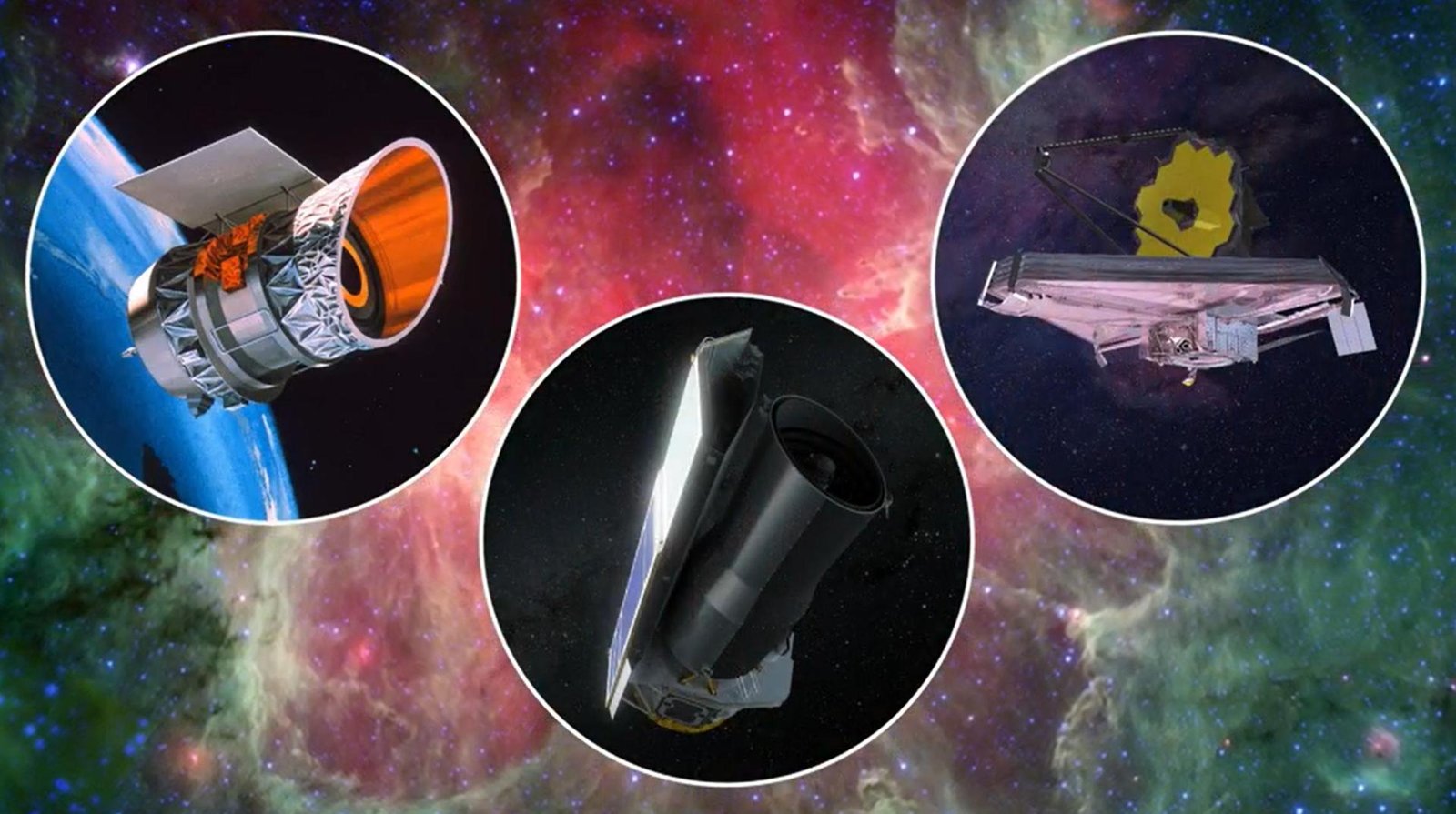
Image: NASA/JPL-Caltech (PIA25790, illustration of IRAS, Spitzer and Webb).
The NASA/ESA/CSA James Webb Space Telescope, with an international team of astronomers and orbit experts at NASA's Center for Near-Earth Object Studies (JPL).
Source: ESA, 2024 YR4 will not impact the Moon
Source: NASA Planetary Defense blog
Asteroid 2024 YR4, about 60 meters across, was briefly the most dangerous asteroid found in 20 years. Earth impact was soon ruled out, but a roughly 4% chance of hitting the Moon on December 22, 2032 remained (NASA's last estimate was 4.3%).
Source: ESA
Source: NASA Planetary Defense blog
Webb's Near-Infrared Camera observed it on February 18 and 26, 2026. Without Webb, astronomers would have waited until 2028 for the asteroid to be visible again.
Source: NASA Planetary Defense blog
Source: NASA Webb blog
Webb works far from Earth, and the asteroid was extremely faint (fainter than magnitude 31 in the published analysis). Webb was the only observatory that could reach it.
Source: Research Notes of the AAS (2026)
A lunar impact of this scale could affect satellites and future astronauts around the Moon. Knowing years early removes that worry, and proves a technique we can reuse.
Source: Research Notes of the AAS (2026)
Source: NASA Webb blog
Webb's two observations extended the asteroid's tracked arc by eight months and shrank the 2032 uncertainty by more than ten times. Result: 2024 YR4 will pass the Moon's surface at about 21,200 km (13,200 miles), according to NASA. Measured from the Moon's center, the published figure is 22,900 ± 800 km. A lunar impact is no longer possible.
Source: NASA Planetary Defense blog
Source: Research Notes of the AAS (2026), JWST rules out 2032 lunar impact
NASA's team says the bigger win is experience: they can repeat the technique for the next faint object without learning it from scratch.
Source: NASA Webb blog
Want to go deeper? NASA's planetary defense update explains how the 2032 Moon impact was ruled out.
For further information