Want to go deeper? JAXA's MMX site has the mission flow, spacecraft and launch coverage.
 For further information
Saving moons: the first round trip to the Mars system.
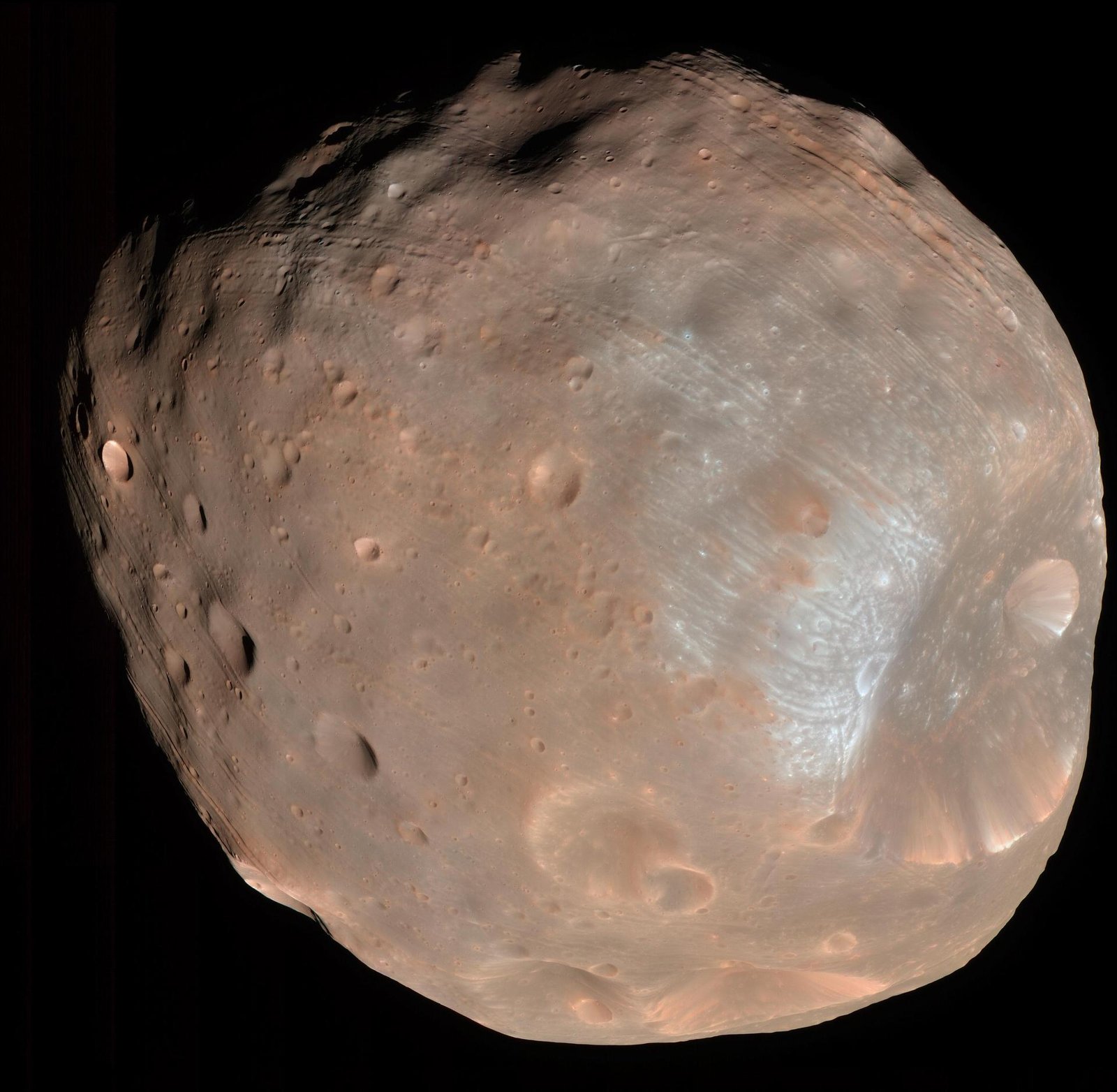
Image: NASA/JPL-Caltech/University of Arizona, Mars Reconnaissance Orbiter HiRISE (PIA10368).
JAXA (the Japan Aerospace Exploration Agency) leads MMX, with NASA, the French space agency CNES, Germany's DLR and ESA. CNES and DLR built the Idefix rover; ESA provides deep-space communications.
Source: ESA, MMX factsheet
Martian Moons eXploration: a three-module spacecraft of about 4,200 kg that will study both moons of Mars, land on Phobos, and bring a sample home, the first sample return from the Mars system.
Source: ESA, MMX factsheet
Source: JAXA, MMX mission overview
Launch on H3 rocket flight No. 10 on October 20, 2026 at 4:41:03 JST (October 19, 9:41 AM HST), with a reserved period to November 7. Arrival at Mars about a year later; return to Earth in Japan fiscal year 2031.
Source: JAXA, MMX launch schedule
Source: ESA, MMX factsheet
Launching from Tanegashima Space Center, then orbiting Phobos, the larger moon of Mars, before landing. The sample capsule will land in Australia.
Source: JAXA, MMX launch schedule
Source: ESA, MMX factsheet
Nobody knows whether Phobos and Deimos are captured asteroids or debris from a giant impact on young Mars. The answer tells us how water and other compounds moved around the early solar system, and how habitable worlds like Earth came to be.
Source: JAXA, MMX mission overview
Source: ESA, MMX factsheet
MMX aims to bring at least 10 grams of Phobos back to Earth in a capsule about 60 cm across, collected by a corer that digs 2 cm deep and a pneumatic sampler that blows surface grains into a container.
Source: ESA, MMX factsheet
Source: JAXA, MMX mission overview
Like Titan, Phobos is a moon worth understanding, not cleaning. MMX is a "saving moons" solution because it builds the round-trip technology for Earth–Mars travel that JAXA lists as an engineering goal, and ESA notes landers on Phobos could one day relay data for rovers or astronauts on Mars. Every human voyage outward makes the next one safer.
Source: JAXA, MMX mission overview
Source: ESA, MMX factsheet
Fun fact: Phobos's gravity is so weak that the 25 kg Idefix rover will weigh the equivalent of about 15 grams there.
Source: ESA, MMX factsheet
Want to go deeper? JAXA's MMX site has the mission flow, spacecraft and launch coverage.
For further information