Want to go deeper? Visit ISRO.
 For further information
India's first space-based solar observatory, watching the Sun from L1.
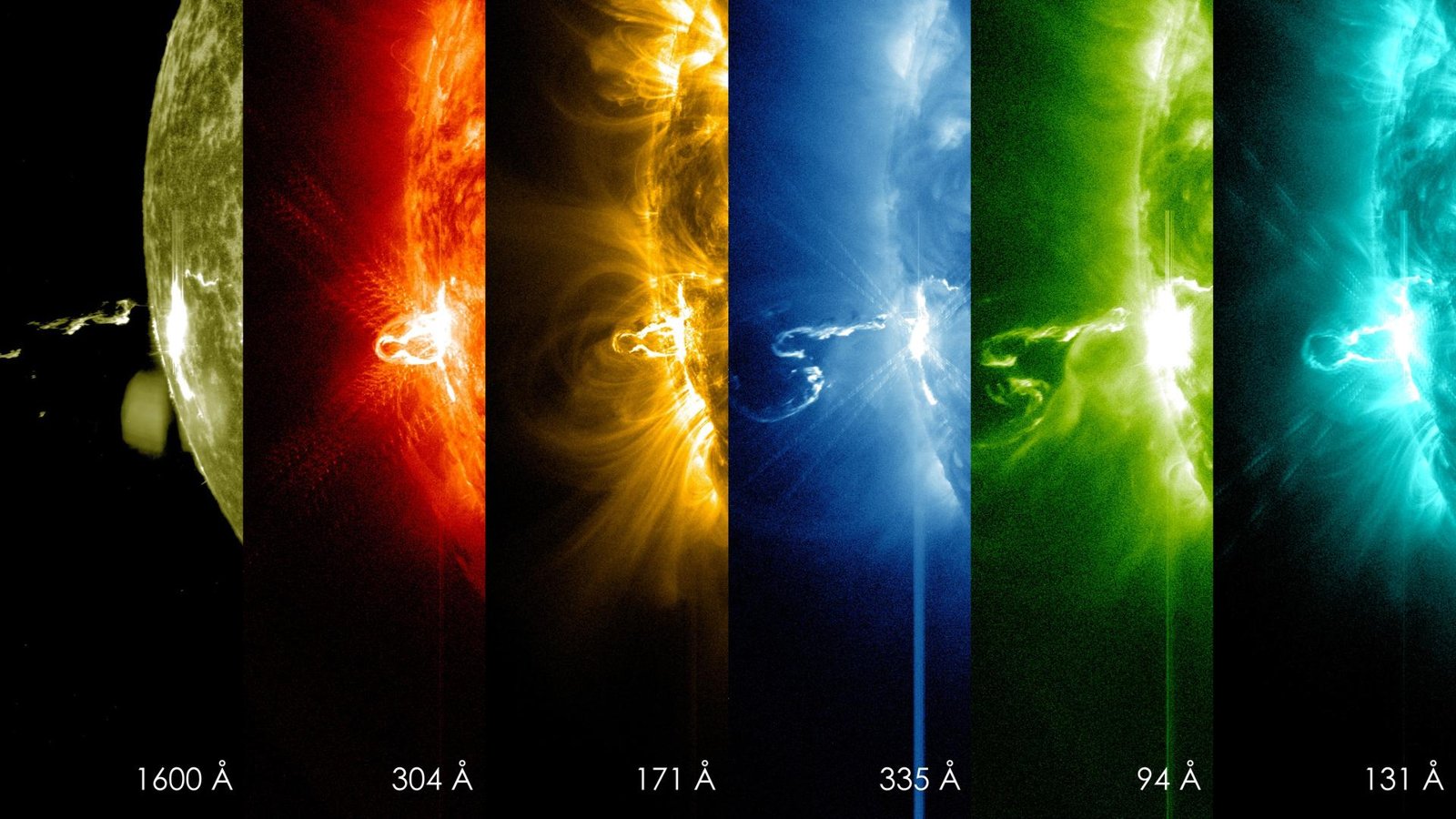
Image: NASA/SDO (Solar Dynamics Observatory), a solar flare seen in six wavelengths.
Last reviewed: 2 sources cited
Agency solution · active
India's first space-based solar observatory launched on PSLV-C57 on September 2, 2023 and entered a halo The curved path an object takes as it travels around a planet, moon or star, like a satellite circling Earth. Glossary around L1, about 1.5 million km from Earth, on January 6, 2024. From there it watches the Sun without eclipses.
Source: ISRO, Halo orbit insertion
It carries seven payloads: four look directly at the Sun (VELC, SUIT, SoLEXS, HEL1OS) and three measure particles and fields at L1 (ASPEX, PAPA, magnetometer), helping explain A huge cloud of charged gas thrown out from the Sun. If it hits Earth it can cause auroras and disturb satellites and power grids. Glossary, flares and space weather.
Source: ISRO, Aditya-L1
India's first space-based solar observatory, with seven payloads studying the Sun and the A steady stream of charged particles flowing out from the Sun in every direction. Glossary.
Source: ISRO, Aditya-L1
Launched September 2, 2023 on PSLV-C57; halo orbit insertion January 6, 2024.
Source: ISRO, Halo orbit insertion
A halo orbit around the Sun-Earth L1 point, about 1.5 million km from Earth.
Source: ISRO, Halo orbit insertion
Coronal mass ejections and flares drive space weather that can affect satellites and power grids. Understanding them helps protect the systems we rely on.
Want to go deeper? Visit ISRO.
For further informationMore solutions like this one, matched by meaning.
Sources are listed with each fact in the Five W's above.
APA
Saving Planets. (n.d.). Aditya-L1 (ISRO). https://www.savingplanets.com/Aditya_L1.html
MLA
"Aditya-L1 (ISRO)." Saving Planets, https://www.savingplanets.com/Aditya_L1.html.